
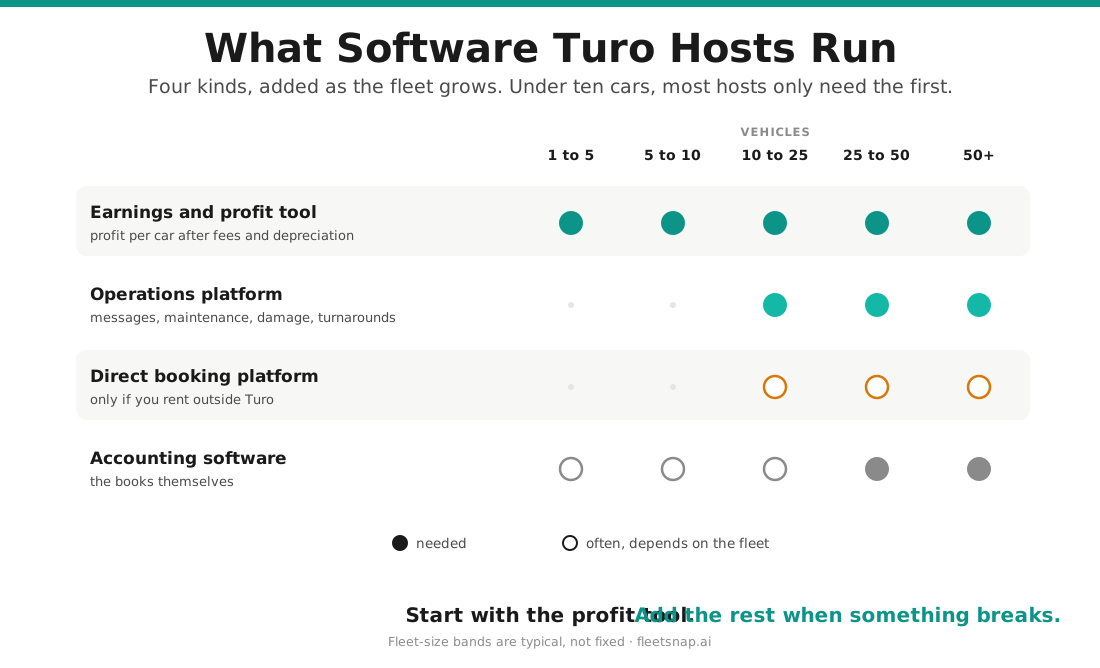
Turo hosts typically use four kinds of software, and which ones depend on fleet size. An earnings or profit tool, used from the first vehicle. An operations layer for guest messaging, maintenance and damage, which becomes necessary somewhere between ten and fifteen vehicles. A direct booking platform, if they rent outside Turo as well. And general accounting software for the books. Hosts under about ten vehicles often use only the first.
The four categories
1. Earnings and profit tools. Turn trip data into profit per vehicle after platform fees, running costs and depreciation. Needed from the first car, because the platform dashboard shows gross revenue and gross revenue does not tell you whether a vehicle is profitable. Examples: FleetSnap's earnings tool, Fleetiqo.
2. Operations platforms. Handle what happens after the booking: guest message triage, maintenance signals, damage documentation, turnaround coordination. Become necessary between ten and fifteen vehicles, when guest messaging stops fitting around a normal day. Examples: FleetSnap, FleetBold, Standard Fleet.
3. Direct booking platforms. Let a host take reservations on their own site alongside or instead of the marketplace. Relevant to operators building rentals outside Turo. Examples: Fleetwire, 1Now, Wheelbase for RV and campervan fleets.
4. Accounting software. Standard business bookkeeping. None of the tools above file taxes or replace an accountant.
What each fleet size actually runs
1 to 5 vehicles. An earnings tool and a spreadsheet. Nothing else is worth the money or the setup time at this size, and the discipline of tracking per-vehicle profit matters more than any platform.
5 to 10 vehicles. The same, plus a consistent photo routine at handover for damage evidence.
10 to 25 vehicles. An operations platform becomes the difference between growing and stalling. Guest messaging is the specific thing that breaks first.
25 to 50 vehicles. Operations platform with role-based access, because there is now a VA or field crew, plus whatever handles direct bookings if the host runs them.
50 or more. Both layers properly, and per-vehicle profitability has become a capital allocation tool rather than a curiosity.
What Turo itself provides
Turo provides the marketplace, the booking flow, payments, guest messaging and the protection plans. It does not provide maintenance tracking, damage documentation beyond its claim process, profit calculation after costs and depreciation, or any way to run direct rentals.
Hosts buy software to fill those gaps, not to replace Turo.
Three facts that shape the tooling
On Turo you must report damage no more than 24 hours after the trip ends to start the resolution process. Any documentation routine has to fit inside that window. Checked 12 October 2026.
Turo's earnings plans set what you keep: 70% of the trip price with $250 of damage responsibility, 80% with $1,500, or 90% with $2,750, and nine US markets move the share with booking lead time. Any profit calculation has to use the plan the host is actually on. Checked 12 October 2026.
Loss of hosting income is not included on any US earnings plan, so days a vehicle spends off the road are entirely the host's cost. This is why maintenance tracking has a direct financial return rather than being housekeeping.
Common mistakes when choosing
Buying a booking engine when the problem is operations. The booking flow is solved and commoditized. The work after the booking is not.
Buying commercial fleet software. Fleetio, Samsara and Verizon Connect are serious products built for fleets where the driver is an employee. A Turo host pays for driver scorecards and compliance modules that do not apply and gets nothing for guest messaging or damage recovery.
Automating guest replies rather than ranking them. In our analysis of 100,000+ guest messages, roughly four in five were routine, about one in six needed a real answer, and around one in sixty was a genuine problem. An automatic reply to the one in sixty is worse than a slow human one.
Buying for current fleet size. Software is painful to switch. Buy for where the fleet will be in eighteen months.
What FleetSnap does
FleetSnap is an operations layer for independent rental and carsharing operators, roughly 10 to 300 vehicles. It is not a booking engine.
- AI reads and ranks every incoming guest message so urgent ones surface first. Humans write every reply and nothing goes out unattended.
- The maintenance agent flags issues from what guests mention in passing and logs them against the vehicle. It flags and records, it does not book repairs.
- Damage is documented against the specific vehicle and trip and tracked through to recovery.
- True profit per vehicle after fees, running costs and estimated depreciation. The earnings tool is free for three reports a month with no fleet size limit.
- Role-based access for VA teams and field crews.
- Check-in and checkout capture is rolling out to first operators now.