
There are two numbers in every Turo trip and most hosts only ever look at one.
There is what the guest pays, which includes things that were never going to reach you. And there is the trip price, which is what your share is calculated from. Confusing the two is why the money landing in your account never matches the figure you remember from the booking.
Here is the structure, plainly.
The host share, by earnings plan
The single biggest deduction, and the one you choose.
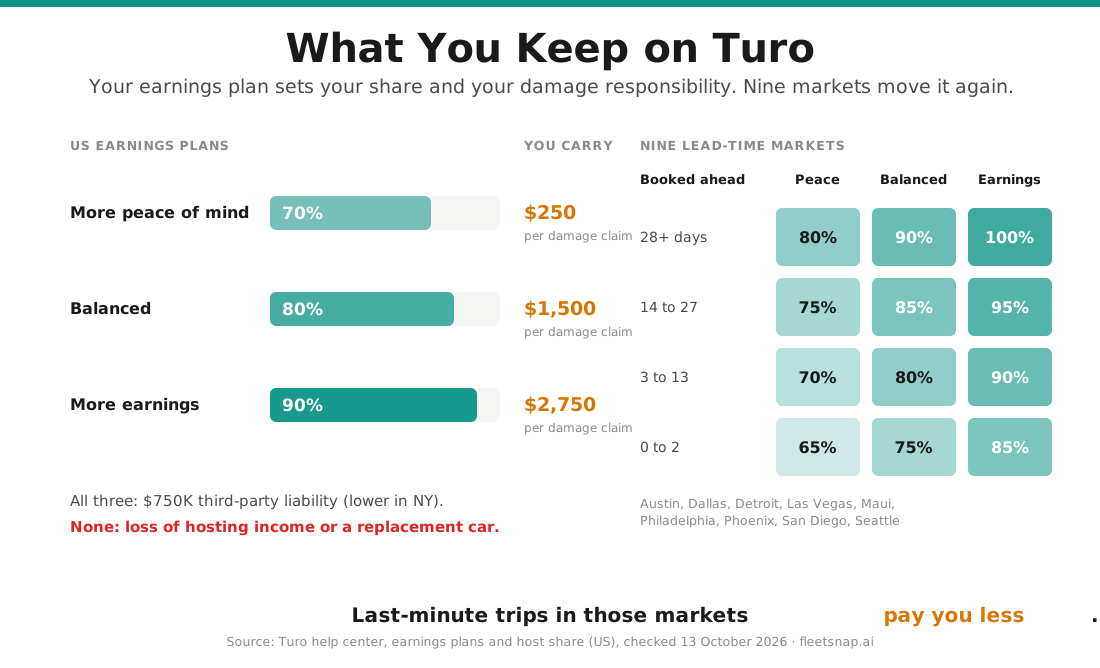
Turo runs three earnings plans for US hosts. Each sets what you keep from the trip price and what you carry if the car comes back damaged:
Turo earnings plans for US hosts
| Plan | You keep | Your damage responsibility |
|---|---|---|
| More peace of mind | 70% of the trip price | $250 |
| Balanced | 80% of the trip price | $1,500 |
| More earnings | 90% of the trip price | $2,750 |
All three include third-party liability up to $750,000 (lower in New York), covering injury and property damage to other people and explicitly not your own car. Above your damage responsibility, eligible repairs are reimbursed up to the actual cash value of the vehicle or $200,000, whichever is lower.
The nine markets where the share moves
Worth knowing if you operate in any of them, because the plan percentage is not fixed.
In Austin, Dallas, Detroit, Las Vegas, Maui, Philadelphia, Phoenix, San Diego and Seattle, the host share is adjusted by how far in advance the trip was booked. Trips booked further ahead generally earn a higher share.
The ranges are 65 to 80% on More peace of mind, 75 to 90% on Balanced, and 85 to 100% on More earnings:
Host share by booking lead time, nine markets
| Booked ahead | More peace of mind | Balanced | More earnings |
|---|---|---|---|
| 28+ days | 80% | 90% | 100% |
| 14 to 27 days | 75% | 85% | 95% |
| 3 to 13 days | 70% | 80% | 90% |
| 0 to 2 days | 65% | 75% | 85% |
Two implications. Your effective rate in those markets is a range rather than a number, so a single-figure projection will be wrong. And last-minute bookings are worth materially less to you there than the headline suggests, which is a real input into whether you discount to fill a gap.
What the guest pays versus what you keep
The guest sees a total. That total includes the trip price plus items that are not part of your share calculation, which is why the two figures diverge so sharply.
The practical consequence: never estimate your earnings from the total the guest was quoted. Work from the trip price and apply your plan percentage, then subtract everything else.
This is also why hosts comparing notes online talk past each other constantly. One quotes guest totals, one quotes trip price, one quotes what landed in the bank, and all three think they are describing the same car.
The charges that sit outside the trip price
Several things can be charged on top of or after a trip, and they behave differently from the trip price.
Additional distance. If you set a daily distance limit rather than offering unlimited, mileage beyond what the trip included is charged per mile. Turo's help center gives you 72 hours after the trip ends to submit this charge, and its earnings plans page lists a longer invoice window on the lower-share plans: 3 days on More earnings, 4 on Balanced, 5 on More peace of mind. Miss it and the distance was free.
Cleaning and condition charges. Charged after the fact where justified, and entirely dependent on evidence. Documented before-and-after condition is what makes these stick.
Young driver and similar guest-side fees. Charged to the guest, not revenue to you.
Delivery, if you offer it. Priced by you and worth costing properly, because the time cost is yours.
The recurring theme is that the post-trip charges are the ones with deadlines, and the deadlines are shorter than people expect.
The deadlines that cost real money
Two, and they run at different speeds, which is the trap.
Damage must be reported no more than 24 hours after the trip ends to start the resolution process.
Additional distance charges have 72 hours (up to 5 days, depending on your plan).
So a car that comes back both damaged and over its mileage has two clocks running, and the tighter one is the expensive one. A perfect damage case filed on day two is a lost case.
What is not covered, which is a cost even though it is not a fee
Three exclusions that function as costs on your side of the ledger.
Wear and tear is not reimbursed. Turo defines exterior wear and tear as dings, dents, cracks or scratches to the exterior body that are 3 inches in diameter or less. Everything under that line is yours.
Loss of hosting income is not included. Turo's US earnings plans don't include it, so days the car cannot earn while being repaired are entirely your cost.
A replacement vehicle during repairs is not included.
For most operators the downtime exceeds the repair bill, which makes the second of those the largest uncompensated item in the whole structure.
Choosing a plan properly
The comparison most hosts make is between 70, 80 and 90%. The comparison that matters is effective cost across a year including what you absorbed.
Run it like this. Take the percentage difference between two plans and multiply by your annual trip revenue. That is what the higher-earning plan gains you. Then take the difference in per-trip damage responsibility, $1,250 between Balanced and More earnings, and multiply by how many damage incidents you actually had last year. That is what it costs you.
If you have never had an incident, the second number is zero and the choice looks obvious. The question is whether one bad year would hurt, and that depends almost entirely on fleet size. Self-insuring works across twenty cars in a way it cannot across two. With two vehicles, one uncovered incident is your year.
Seeing your real effective rate
The reason this gets misjudged is that no dashboard shows your effective rate after everything. It shows gross trip revenue and a payout, with the relationship between them changing trip by trip.
FleetSnap's earnings tool works from your trip export and produces profit per vehicle after platform fees at your plan, running costs and estimated depreciation. Free for three reports a month, no fleet size limit. If you only want to know what the fees are actually costing you across a year, that is the fastest way to find out.
The wider product handles the operational side where the money quietly leaks. The AI reads and ranks guest messages so urgent ones surface first, with your team still writing every reply. Damage is documented against the specific vehicle and trip and tracked through to recovery, which matters directly here, because the 24 hour window is where most unrecovered damage is actually lost. The maintenance agent flags issues from what guests mention in passing. Check-in and checkout capture is rolling out to first operators now.