
Car Rental Software in 2026: An Honest Comparison for Independent Operators
A straight comparison of car rental software for independent operators running 10 to 300 vehicles, including what each category does badly.
 By The FleetSnap Team·6 min read
In this guide
There are dozens of platforms calling themselves car rental software, and they are not doing the same job. Most comparison articles list them in one table as if they were, which is why choosing is harder than it should be.
This splits them by what they actually do, says what each category is bad at, and is written for someone running ten to three hundred vehicles rather than for a national chain.
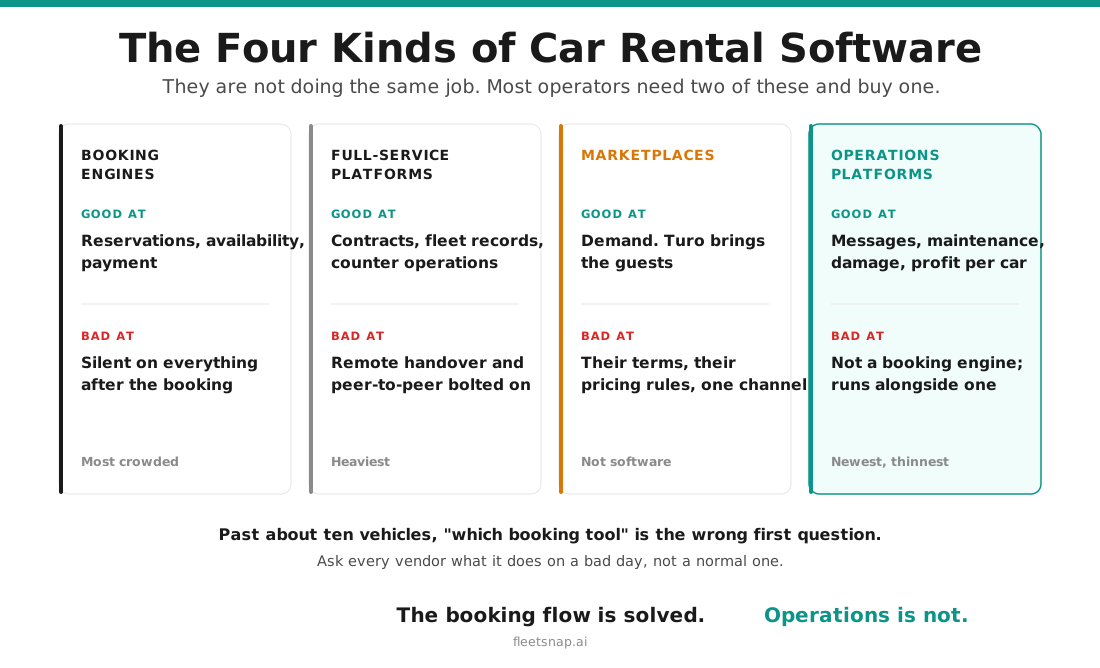
The four categories of car rental software
Booking engines. Take reservations, manage availability, process payment. This is what most people mean when they say car rental software, and it is the most crowded category. Strong at the reservation, mostly silent on everything after it.
Full-service rental platforms. Booking plus fleet records, contracts, damage logging and reporting. Heavier, usually built for traditional rental counters rather than peer-to-peer or remote handover models.
Peer-to-peer marketplaces. Turo and its smaller equivalents. Not software you buy, demand you rent. They bring customers and set the terms, which is a different trade entirely. Worth noting that this category consolidated hard: Getaround announced the wind-down of its US operations, HyreCar included, in February 2025, so US operators have materially less choice here than they did two years ago.
Operations platforms. Cover the work after the booking: guest communication, turnarounds, maintenance, damage recovery, per-vehicle profitability. The newest category and the thinnest, because it only becomes a problem at scale.
Most operators need two of these and buy one.
Booking engines vs operations platforms
Worth separating properly, because it is the distinction that costs people the most.
A booking engine answers "how do I take a reservation and get paid." An operations platform answers "how do I run the fleet without it running me."
At three vehicles the second question does not exist. You answer messages yourself, you clean the cars yourself, you remember what needs servicing. At thirty vehicles it is the whole job, and the booking engine is not helping with any of it.
The failure mode is predictable. Operators buy a booking tool early because that is the obvious need, scale to the point where operations breaks, and then discover their booking tool has no answer for guest messages, maintenance signals or damage recovery, because that was never what it was for. Car rental management software goes deeper on that second layer.
What independent operators get wrong when buying
Buying for the fleet size you have. Software is painful to switch. Buy for where you will be in eighteen months, within reason.
Optimizing for the booking flow. It is the part you see most and the part that matters least once it works. The booking flow is solved. Operations is not.
Ignoring what happens on a bad day. Every platform looks fine when a trip goes normally. The question is what it does when a car comes back damaged, when a guest will not return it, when something breaks mid-trip. Ask vendors about those specifically.
Not asking who does the data entry. Some platforms look comprehensive and require someone to maintain them. That person is usually you.
Counting the integrations rather than using them. A long integration list is marketing. Ask whether the two integrations you actually need work properly.
Named comparison: who is good at what
Vendor status checked 13 October 2026. No pricing is stated for any of them, because the models differ and the headline rate is rarely the real one. Some of the smaller names below have little independent coverage, so treat any customer-count or traction claim they make about themselves with care.
HQ Rental Software, RENTALL, TSD Mobility Solutions. Established full-service rental platforms. Strong on bookings, contracts and counter operations. Built for traditional rental businesses, so the peer-to-peer and remote handover side is usually bolted on rather than native. Two notes on ownership, because this corner of the market consolidated: RENTALL is the merged product of Bluebird, Thermeon and Navotar under Valsoft, and still ships under regional names, so Navotar and RentWorks are the same platform rather than alternatives to it. TSD Rental is now TSD Mobility Solutions, acquired by Reynolds and Reynolds in 2024 and still run independently.
Fleetwire, Wheelbase, 1Now. Lighter booking and management platforms aimed at smaller independents. Faster to set up, less depth, generally better value under fifty vehicles. Wheelbase is an Outdoorsy subsidiary and leans RV and campervan rather than cars, so check the fit before you shortlist it.
Turo. Demand rather than software, and in the US now effectively the only marketplace of scale after Getaround's US wind-down. The question is what you run alongside it rather than instead of it, and that wind-down is a reason to make the question urgent rather than theoretical.
FleetBold, Fleetiqo, Standard Fleet. Built specifically around Turo operations. Narrower by design, which is a strength if that is your whole business. Best Turo automation tools covers what each one automates.
Fleetio, Samsara, Verizon Connect. Fleet management for commercial and trucking fleets. Excellent at what they do and largely wrong for rental, because they assume the driver works for you. Vehicle fleet management software explains why that one assumption matters so much.
FleetSnap. The operations layer. AI reads and ranks every guest message so the urgent ones surface first, with your team still writing the replies. The maintenance agent flags issues from what guests mention in passing. Damage is documented and tracked through to recovery. And you see true profit per vehicle after fees, maintenance and depreciation rather than gross revenue. It sits alongside a booking tool rather than replacing one.
The part every booking tool leaves to you
Whichever platform you choose, four things stay your problem unless something specifically handles them.
Guest messages, which at scale is a part-time job that does not respect your calendar. The ones that matter most are buried in the ones that do not.
Maintenance you did not plan for. The expensive repairs usually announced themselves weeks earlier in a message from a guest who mentioned a noise.
Damage recovery. Not the claim itself, the documentation that decides it and the follow-up that most people drop. The handover record is covered in the vehicle damage inspection app guide.
Knowing which vehicles make money. Gross revenue per car is on every dashboard. Profit per car after fees, maintenance and depreciation is on almost none, and they are different rankings.
Those four are the gap FleetSnap was built for, and they are also the reason "which booking tool" is the wrong first question past about ten vehicles.
Switching costs and migration
Realistic, because vendors understate this.
Moving historical trip data is usually partial at best. Expect to keep the old system readable for a year. Rebuilding pricing rules, vehicle records and any automation takes longer than the sales call implies. And the real cost is the weeks where your team knows one system and is learning another.
Which is an argument for choosing carefully, not for never switching. The operators who suffer most are the ones who stayed on something unsuitable because switching felt expensive, and paid for it in operational drag every day for two years.
Choosing by fleet size
Under 10 vehicles. A marketplace plus a spreadsheet is genuinely fine. Spend the money on the cars. Use a free tool to track profit per vehicle so you know which ones to keep.
10 to 50. The transition band. Booking tool if you are doing direct rentals, and this is where operations starts to break. Most operators here are a few months behind where their systems need to be.
50 to 150. Both layers, properly. By this point manual operations is costing more than any software, and the per-vehicle profit question becomes a capital allocation question.
150 plus. Different conversation, usually involving custom work and dedicated staff.
If you are still deciding whether to start at all, how to start a car rental business covers the first ninety days.
Questions hosts ask
What is the best car rental software for a small business?
Under fifty vehicles, something light and fast to set up beats something comprehensive you will not configure. The more useful question is whether you need a booking engine, an operations layer, or both.
Do I need car rental software if I only use Turo?
Not for bookings, Turo handles those. You will need something for operations once guest messages, turnarounds and maintenance stop fitting around your day.
How much does car rental software cost?
Models vary between per-vehicle, per-user and flat rate, and the cheapest headline is frequently not the cheapest in use. Ask what is metered: vehicles, users, trips, messages or reports. That answer tells you what the price will be in a year, which is the number that matters.
Can I run more than one platform?
Yes, and most operators past five vehicles do. The cost is reconciliation, since revenue arrives in two places with different fee structures.
What is the difference between fleet management software and car rental software?
Fleet management software is generally built for commercial fleets where the driver works for you. Rental software assumes the driver is a customer, which changes almost everything about damage, communication and liability.