
Almost every operator who stalls between ten and fifteen cars believes they have a money problem. Very few of them do.
At ten cars you could usually finance more. What stops you is the knowledge, somewhere below the level of a stated reason, that each additional vehicle adds work to a week that is already full. So you do not buy the eleventh, or you buy it and the operation gets worse, and either way the ceiling holds.
The ceiling is attention. That is a different problem with a different fix, and knowing which one you have is most of the battle.
The real ceiling is attention, not capital
Here is the shape of it.
Revenue scales linearly with vehicles. Operational load scales with trips, which scale faster than vehicles once utilization improves, and communication scales with trips too.
So the twentieth car does not add 5% more work to a twenty-car fleet. It adds the same absolute load the second car added, onto a person who is already at capacity. The work per car was supposed to fall with scale and it did not, because nothing about how you run changed.
That is the whole problem, and it means the question is not how to work harder at twelve cars. It is what stops being your job.
What breaks, in order
Predictable enough to plan for.
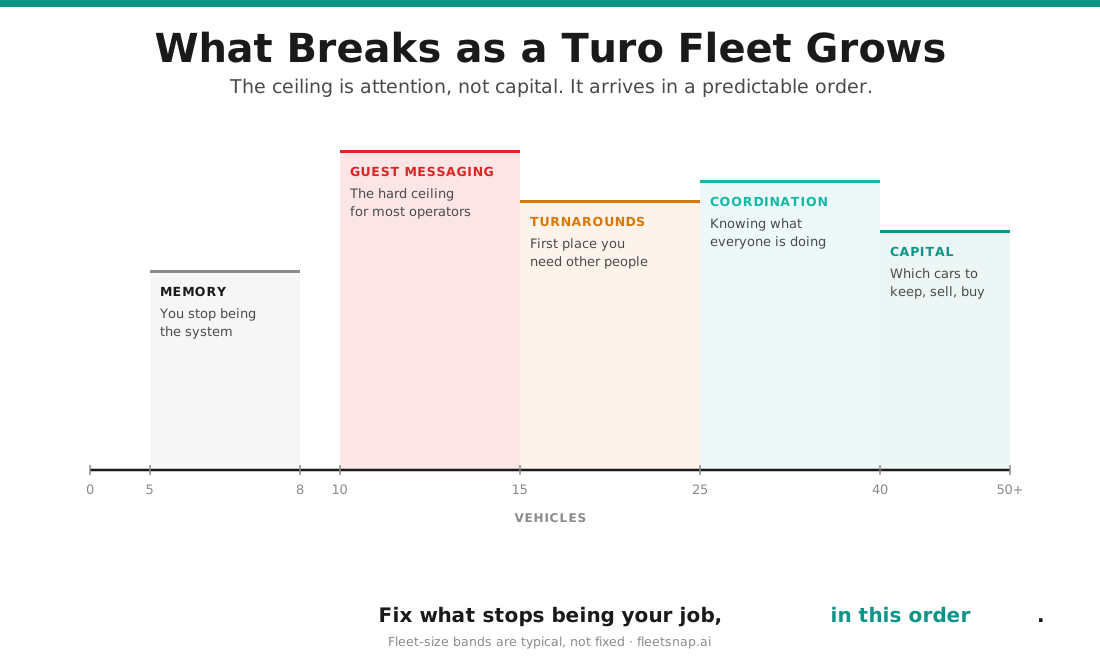
Around 5 to 8 cars, your memory stops being the system. You used to know which car was due a service and what happened with that guest last month. Now you are mostly sure. The failures start small and the things you forget are, by selection, the quiet ones, which are also the expensive ones.
Around 10 to 15, guest messaging becomes a part-time job. Dozens of messages a day across a schedule that is not yours. This is the hard ceiling for most operators, and it is where the eleventh car stops being appealing.
Around 15 to 25, turnarounds become the bottleneck. Cleaning, fuel or charge, photos, readiness. Physical work with a hard time constraint between trips, and the first place you need other people.
Around 25 to 40, coordination replaces execution. You now have a VA, a cleaner, maybe a field person. Your problem changes from doing things to knowing what everyone is doing, and the tools that got you here do not help with that at all.
Past 40, it is a capital allocation question. Which vehicles to keep, sell and buy. That question requires per-vehicle profitability, and operators who never built the measurement habit cannot answer it.
Most operators are a few months behind where their systems need to be, which is survivable. The ones who stall are the ones several years behind.
The messaging ceiling, specifically
Worth its own section because it is where most fleets stop.
Ninety messages arrive in a day. In our analysis of 100,000+ guest messages, roughly four in five were routine, about parking, pickup time, whether there is a charger. About one in six needed a real answer. Around one in sixty was a genuine problem, the kind that becomes a repair bill or a damage dispute if nobody catches it.
The one in sixty arrives looking exactly like the other fifty-nine. There is no notification setting that separates a guest asking where to park from a guest mentioning the brakes feel soft. Both are just a message.
So operators read everything, which works until it does not, then they read in batches, then they turn notifications off, and somewhere in that progression the brake message gets a reply about parking.
The failure is not laziness. It is that the sorting problem is genuinely unsolvable by a human at volume, and nobody tells you that, so you conclude you are bad at this.
What actually unlocks the next tier
Four things, in the order they pay off.
Rank the inbox instead of reading it. Not automation, ranking. The urgent message surfacing first is what turns ninety messages from a two-hour job into a twenty-minute one, because the other eighty-nine can wait and now you know which eighty-nine they are.
Document damage by default, not by decision. Most unrecovered damage is lost to claims never filed rather than claims refused. On Turo you have 24 hours from the trip ending to report damage (the full claim clock), which means a routine that happens on return, every time, regardless of how busy the evening is.
Catch maintenance from what guests say. The expensive repairs announced themselves weeks earlier in a sentence inside a message about something else. This is free money and almost nobody collects it.
Know profit per vehicle, not revenue per vehicle. The moment you have more than a few cars, the question of which to buy more of and which to sell is worth more than any operational improvement, and you cannot answer it from a platform dashboard.
When to hire, and what to hand over
The instinct at the messaging ceiling is to hire a VA. Reasonable, and it fails about half the time for one specific reason.
A VA working from an unranked inbox is just a second person reading ninety messages in arrival order. You have bought capacity without buying judgment, and the one in sixty is as likely to be missed as before, except now it is missed by someone with less context than you.
Rank first, then hire. With a ranked queue, a VA handles the routine eighty, you handle the exceptions, and the arrangement actually works. Without one you are paying someone to be as overwhelmed as you were.
The same applies to field help. Hand over turnarounds with a defined checklist and a capture routine, or you have added a coordination problem to an execution problem.
What this looks like when it works
The operators who get through this ceiling are rarely working more hours afterwards. They are working on different things.
The fleet grows because the work per car stopped growing with it. That is the entire mechanism, and it is why some operators go from a dozen cars to thirty inside a year while others sit at twelve for three years with the same capital available.
The difference is almost never ambition. It is whether the operational load was allowed to scale linearly or not.
Where FleetSnap fits
FleetSnap is the operations layer for exactly this band, roughly 10 to 300 vehicles. It is not a booking engine, so if you take reservations on your own site you will need something alongside it.
The AI reads every incoming guest message and ranks it by urgency so the urgent ones surface first. Your team still writes every reply and nothing goes out unattended. The ranking is the product, not the automation, which matters because your guests are still talking to a person.
The maintenance agent flags issues out of what guests mention in passing and logs them against the specific vehicle. It flags and records. It does not book the repair or decide what to do about it.
Damage is documented against the vehicle and trip, then tracked through to recovery, with open claims visible rather than dependent on memory.
Profit per vehicle after fees, running costs and estimated depreciation, which is the number that turns the next purchase into a decision rather than a guess. The earnings tool is free for three reports a month with no fleet size limit, and it is a reasonable place to start whether or not you ever pay for anything.
Role-based access means a VA or field crew can work inside it without seeing everything, which is the part that matters once you have people. Check-in and checkout capture is rolling out to first operators now.