
Most lists of Turo automation tools are affiliate pages, and you can tell because every tool is excellent and none of them has a limitation.
Here is the version organized by the job you are trying to get done, with what each category genuinely does and where it stops. We build one of these, which is disclosed in the relevant section rather than buried.
First, what is worth automating and what is not
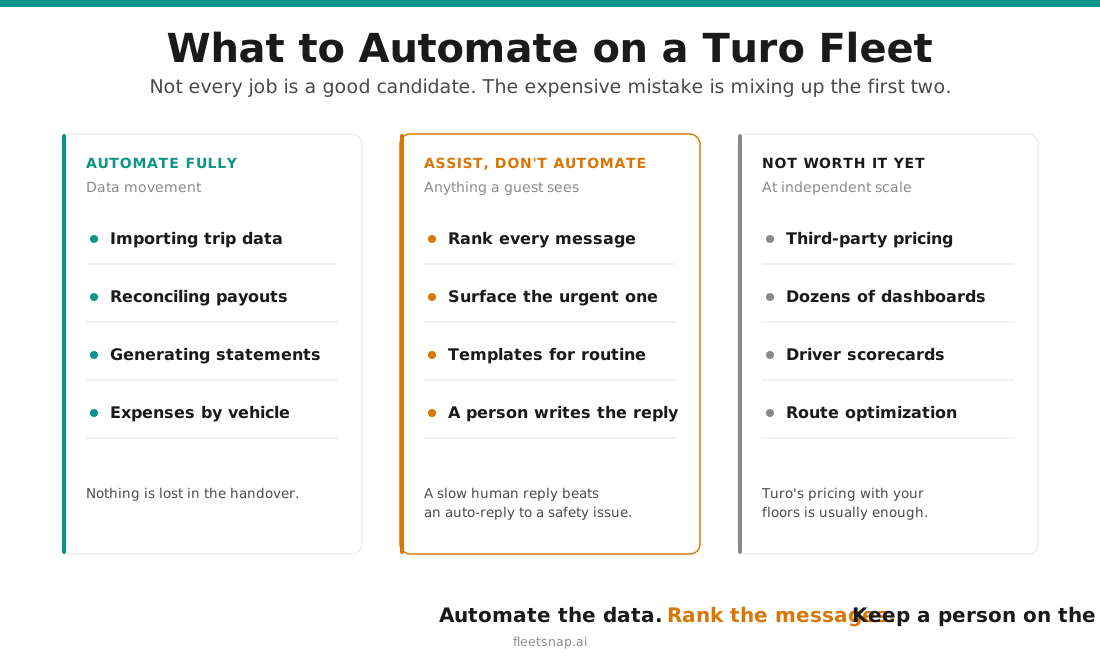
Three categories, and they are not equally good candidates.
Worth automating fully. Data movement. Importing trip data, reconciling payouts, generating statements, tracking expenses against vehicles. Nobody benefits from you doing this by hand and nothing is lost in the handover.
Worth assisting but not automating. Anything a guest sees. Messaging is the obvious case. The value is in knowing which message matters, not in a machine replying for you, and the gap between those two is where most hosts get burned. A fully automated reply to a guest reporting a safety issue is a worse outcome than a slow human one.
Not worth automating at this scale. Pricing, mostly. The platform's own dynamic pricing with floors set by you is sufficient for most fleets, and third-party pricing tools earn their fee at a size most independent operators have not reached.
That split matters more than any individual tool, because the common expensive mistake is automating the second category and neglecting the first.
Messaging and guest communication
The biggest time cost in any fleet past ten vehicles, and the category with the most misleading marketing.
What the category promises is replies written for you. What you actually need is to know which of today's ninety messages is the one about soft brakes, because in our analysis of 100,000+ guest messages roughly four in five were routine, about one in six needed a real answer, and around one in sixty was a genuine problem that becomes a repair bill if missed.
Tools that auto-reply solve volume and make the sorting problem worse, because a confident automatic answer to the wrong message closes a conversation that should have escalated.
FleetSnap sits here, and the disclosure is that we built it. The AI reads every incoming guest message and ranks it by urgency so the urgent ones surface first. Your team still writes every reply and nothing goes out unattended. That constraint is deliberate rather than a limitation we are working around.
Several platforms in the list below also include templated or canned responses, which are genuinely useful for the routine four in five.
Fleet operations and maintenance
Tracking what each vehicle needs, and catching problems before they become repairs or listing suspensions.
FleetBold is built around Turo operations, including GPS tracking, Turo sync and Tesla-specific controls, and sells hardware alongside the software. A strong fit for fleets that want connected-car control.
Standard Fleet is a hardware-free connected-vehicle platform covering digital keys, deviceless telematics and EV management across 30 or so vehicle brands, serving rental and mobility operators among others. It raised a Series A in 2025 and is independent.
Fleetio, Samsara and Verizon Connect are the serious commercial fleet platforms. Excellent products, largely wrong for this use case, because they assume the driver is your employee. You would pay for driver scorecards and compliance modules you cannot use. If you are outside the US, note that Geotab took over Verizon Connect's commercial operations across much of Europe and Australia in late 2025.
FleetSnap's maintenance agent reads guest messages and flags issues from what guests mention in passing, logging them against the vehicle. It flags and records. It does not book the repair, call a repair shop or decide what to do about it.
Earnings, accounting and reporting
The category most worth automating and the one most people leave until tax season.
Fleetiqo parses Turo confirmation emails from a connected inbox to create bookings, and tracks expenses and profit per vehicle. Worth noting it is a small operation with no independent coverage, so judge it on a trial rather than on claims.
1Now is aimed at Turo hosts wanting direct bookings alongside the platform, covering a branded booking site, ID and insurance checks and payments. Same caution applies on independent verification.
FleetSnap's earnings tool produces true profit per vehicle after platform fees, running costs and estimated depreciation from your trip export. Free for three reports a month with no fleet size limit. The reason we lead with this one rather than the rest of the product is that it is the single highest-value thing an operator of any size can do, and it costs nothing.
General accounting software still has a place for the books themselves. None of the tools above file anything for you.
Direct booking and multi-channel
For operators building rentals outside the platform, which became a more urgent topic after Getaround shut down its US operations in February 2025 and hosts who had built entirely on it lost their income with a day's notice.
Fleetwire covers branded storefront, Stripe payments, renter ID and insurance verification, deposits and e-signed agreements. One caveat: it still advertises Getaround calendar sync, which tells you something about how current the integration list is.
1Now overlaps here with a similar direct-booking proposition aimed at Turo hosts.
Wheelbase is an Outdoorsy subsidiary and leans RV and camper van rather than cars, so check the fit before shortlisting.
Inspections and damage documentation
The highest return per minute of any category, because the recovery rate on documented damage is dramatically higher and almost all unrecovered damage is lost to claims never filed.
Worth knowing the constraint you are working against: on Turo you must report damage no more than 24 hours after the trip ends to start the resolution process (the full claim clock). Any routine that does not fit inside that window is not a routine.
Several of the platforms above include photo capture. The thing to check is whether the record is tied to a specific trip with a server-recorded timestamp, because photos in a camera roll prove the car existed and not much else.
FleetSnap documents damage against the specific vehicle and trip and tracks claims through to recovery, with open claims visible rather than dependent on memory. Check-in and checkout capture is rolling out to first operators now.
How to choose without buying four things
Four questions, in order.
What is the actual bottleneck this month? Not the most annoying thing, the thing capping your growth. Usually messaging between ten and fifteen cars, turnarounds between fifteen and twenty-five.
What is metered? Vehicles, users, trips, messages or reports. That answer tells you the price in a year, which is the number that matters.
What do you have to enter manually, and what breaks if you stop? Anything requiring new manual entry at small scale stops being maintained inside two months, and a system with stale data is worse than no system because you trust it.
What happens on a bad day? Every tool looks fine when a trip goes normally. Ask what it does when a car comes back damaged or a guest will not return it.
The honest summary
Under about ten vehicles, the free earnings tool plus a disciplined photo routine beats anything you could buy. Spend the money on cars.
Between ten and fifty, the messaging and documentation layer is what unlocks the next tier, and it is worth paying for because the alternative is your evenings.
Past fifty, you are running both an operations layer and whatever handles direct bookings, and the per-vehicle profit question has become a capital allocation question.