
Most of what it takes to run a Turo fleet is invisible -- and the biggest hidden job is the inbox.
So we dug into ours. FleetSnap's AI has now read and classified more than 100,000 real guest messages across 700+ professionally managed Turo vehicles, and the volume keeps climbing -- past 20,000 messages a month.
We went looking for what actually makes a Turo inbox manageable: how much of it is real emergencies, which messages truly demand a fast response, when they arrive, and whether it gets any easier as you grow. A few of the answers surprised us.
One note on "classified": our AI reads every message and tags it by urgency and type as it arrives. It doesn't write the replies -- people do. This piece is about what those tags reveal.
The inbox is relentless
Start with raw volume. An actively managed Turo vehicle generates a median of about 40 guest messages a month -- so the load scales fast:
- 10 cars is roughly 400 messages a month
- 25 cars is roughly 1,000
- 50 cars is roughly 2,000 -- about 70 a day
Our largest fleet -- 140 cars tracked over seven months -- runs about 38 messages per car per month, sustained. At fleet scale, guest messaging stops being a task and becomes a full-time job.
But how much of it is actually a crisis?
Here's the surprise: almost none of it. Sort every message by what it actually is, and the inbox is overwhelmingly routine -- with a thin, unpredictable thread of real problems running through it.
What's actually in a Turo host's inbox
| Type of message | Share |
|---|---|
| Routine -- questions, logistics, confirmations | 82% |
| Time-sensitive but routine -- trip changes, bookings, last-minute | 16% |
| Genuine problems -- damage, vehicle issues | 1% |
| Emergencies -- accidents, safety | 0.7% |
In other words: only about 1 in 60 messages is a genuine problem, and fewer than 1 in 100 is an emergency. The 18% the AI flags as urgent mostly aren't crises -- they're time-sensitive: a guest changing a trip, a last-minute booking to confirm, a payment question that can't wait.
That's the real shape of the job. It isn't that the inbox is full of fires -- it's that a handful of messages genuinely matter, scattered unpredictably through thousands that don't, and you can't tell which is which without reading them all.
What actually demands a fast response
Not every message is equally urgent -- and it isn't the ones you'd guess. Sorting by message type, two stand out:
- Trip changes -- 58% are time-sensitive. A guest extending, shortening, or shifting a trip needs an answer before plans (and money) move.
- New bookings -- 36% are time-sensitive, including the last-minute ones the AI surfaces so you don't miss the trip.
General guest questions -- the bulk of the inbox -- are only 11% time-sensitive, and payments (4%) and cancellations (under 1%) rarely need an instant reply. Speed matters most on trip changes and new bookings: those are where a slow response actually costs you a trip.
The inbox doesn't keep business hours
Volume builds through the morning, peaks late morning (around 9am Pacific), and stays heavy all day -- but it never really stops:
- More than 1 in 4 messages -- and 1 in 4 urgent ones -- arrive between 6pm and 6am.
- Weekends barely let up: Saturday and Sunday run within 15-20% of weekday volume.
For a solo host, that's the real tax. It's not just the volume -- it's that the next time-sensitive message can land at 11pm on a Saturday, with no way to know in advance.
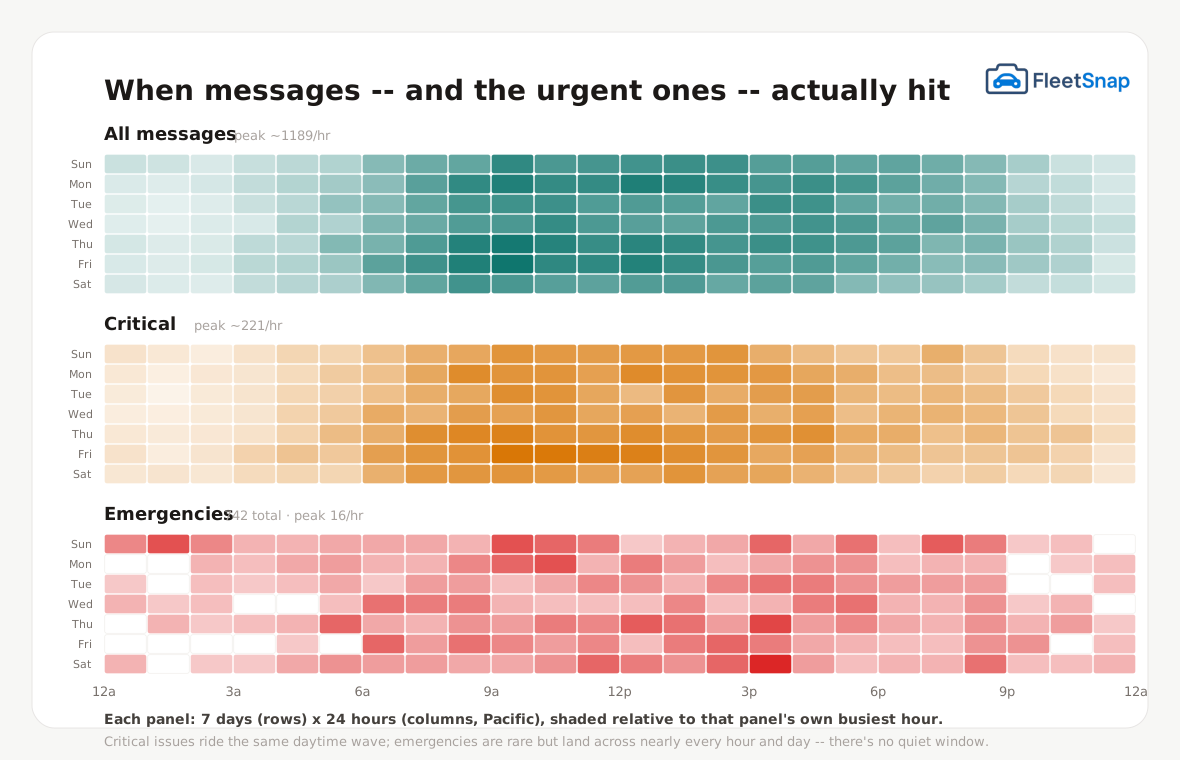
Three views of the same week -- all messages, critical issues, and emergencies. The top panel is the daily rhythm: heavy from about 7am to 8pm, lighter overnight, nearly identical all seven days. The critical panel rides that same wave. And the emergencies panel -- rare as they are -- lights up across nearly every hour and every day. You can predict the wave; you can't predict which message in it is the one that can't wait. That's the whole problem: the hardest part isn't the volume -- it's never missing the next emergency.
And it doesn't ease up as you grow
You might also assume bigger fleets run calmer inboxes -- better cars, better guests, fewer fires. They don't. The share of messages flagged urgent barely moves with size: about 19% under 20 cars and 15% at 100+ -- roughly 1 in 6 at every scale. You get more urgent messages as you grow, but not a lower rate. The pressure is structural: you can't scale your way out of it, only build a system that catches the ones that matter.
What the data says to do about it
Three things follow directly from the numbers:
- The job is triage, not speed on everything. Only about 2% of messages are real problems and 16% are time-sensitive -- so the win is surfacing the ones that matter (trip changes, bookings, emergencies) out of the routine noise, not answering all 2,000 a month instantly.
- You need eyes on it around the clock, because a quarter of the load -- including the urgent slice -- lands outside business hours.
- It doesn't get easier at scale, so the system has to be in place before you're buried, not after.
This is what FleetSnap is built around. Our AI reads and classifies every message by urgency and type the moment it lands, so the trip change, the last-minute booking, and the accident surface immediately instead of getting buried under routine questions. On Pro, it flags those for you so you reply right away. On Concierge, trained, Turo-savvy VAs work that prioritized queue and handle the replies. The AI does the triage; people do the responding.
By the numbers
- 100,000+ guest messages analyzed across 700+ vehicles -- 20,000+ a month and growing
- 40 guest messages per vehicle per month (median)
- 18% flagged urgent / time-sensitive -- but only 1 in 60 is a genuine problem, and 1 in 140 an emergency
- Most time-sensitive types: trip changes (58%) and new bookings (36%); routine questions just 11%
- 28% of messages -- and of urgent ones -- arrive 6pm-6am; weekend volume within 15-20% of weekdays
- Urgent rate is flat as fleets scale: 1 in 6 from under 20 cars to 100+
The full aggregate dataset behind this post is available as a machine-readable file (CC BY 4.0): turo-guest-messaging-2026.json.