
Most advice about hiring a Turo virtual assistant runs on vibes -- a forum thread, a friend's setup, a VA agency's sales pitch. We wanted to answer the question with data instead.
FleetSnap's AI has read and classified more than 100,000 real guest messages across 700+ professionally managed Turo vehicles. That dataset doesn't just show what's in a host's inbox -- it shows what a VA actually has to do, when the work really happens, and where most operators are quietly spending wrong.
This is meant to be the guide you read before you hire -- whether or not you ever use FleetSnap. We'll walk through the four most common mistakes operators make with VAs, the exact fleet size where doing it yourself stops working, and a simple framework for what to prioritize.
One note: when we say our AI "classifies" messages, we mean it reads and tags each one by urgency and type as it lands. It doesn't write the replies -- people do. This guide is about how to staff those people well.
First, define the job you're actually hiring for
Before you compare VAs, get clear on the work. The data draws a sharp picture:
- Volume scales fast. An actively managed vehicle generates a median of about 40 guest messages a month -- roughly 400/month at 10 cars, 1,000 at 25, 2,000 at 50 (about 70 a day).
- Almost all of it is routine. About 82% of messages are ordinary questions and logistics. Only about 1 in 60 is a genuine problem (damage, a vehicle issue), and fewer than 1 in 100 is a true emergency.
- A thin, time-sensitive thread runs through it. About 18% of messages are time-sensitive -- and they cluster in two types: trip changes (58% urgent) and new bookings (36% urgent). General questions are only 11% time-sensitive.
- It never keeps business hours. More than 1 in 4 messages -- and 1 in 4 urgent ones -- arrive between 6pm and 6am, and weekend volume runs within 15-20% of weekdays.
- It doesn't ease up as you grow. The urgent rate is flat from under-20-car fleets to 100+ -- roughly 1 in 6 at every size.
So the job isn't "answer messages fast." It's triage and coverage -- catching the handful of messages that genuinely matter (a trip change, a last-minute booking, an accident) out of thousands that don't, at any hour of any day -- plus the work the inbox sets in motion: running check-in and check-out when guests are at the car, and working Turo's support and claims process when something goes wrong. Hold onto that fuller definition. Every mistake below is a way of getting it wrong.
Mistake #1: Hiring a VA for business hours
This is the most common mistake, and the most expensive. An operator hires a VA, the VA works 9-to-5 on weekdays, and everyone feels covered.
The data says they're not. A full-time VA works ~40 hours a week. A week is 168 hours. So a single business-hours VA covers under 25% of the week -- and the 28% of urgent messages that land between 6pm and 6am, plus the near-full weekend load, fall straight into the gap. You're paying for help and still can't take the night off, because the trip change at 11pm on Saturday is still yours.
The fix isn't "work your VA harder." It's recognizing that coverage -- being present when the message lands -- matters more than anything else, and a single shift can't provide it.
Mistake #2: Waiting too long to get any help
The opposite failure: doing nothing for far too long. Operators tell themselves they'll "get a VA when it's worth it" -- and white-knuckle the inbox through 20, 30, 40 cars because rebuilding their process feels like work.
But the first step up from DIY usually isn't a VA at all -- it's triage. At small scale, the pain isn't the volume of replies; it's the vigilance -- scanning every routine message so you don't miss the one that matters. An always-on triage layer (this is what FleetSnap Pro does: it reads and flags the time-sensitive messages the instant they land) removes the vigilance tax without adding a single person. You still reply yourself, but you're only pulled in for the ~18% that's real.
The practical rule: add triage early -- it's cheap and buys you runway -- and add human hands when the reply volume itself, not just the watching, becomes the bottleneck (usually somewhere around 15-25 cars, depending on utilization).
Mistake #3: Paying premium for sub-minute response
VA services love to advertise a guaranteed "under 1-minute response." It sounds great. But the data says speed earns its premium on only a specific slice of the inbox.
Remember the mix: about 82% of messages are routine, and only ~18% are time-sensitive -- concentrated in trip changes and new bookings. For a routine question ("what's the mileage limit?"), a reply inside a reasonable window -- a few minutes, sometimes longer -- does the job; shaving it to under a minute rarely changes the guest's experience or your outcome. For a last-minute booking or a trip extension, those same seconds genuinely convert to money, because the guest is deciding right now.
So a blanket sub-minute guarantee spends most of its premium on the 82% where faster barely moves the needle. What actually drives the outcome is correct triage -- knowing which messages are the time-sensitive ones -- plus fast response on those. A service that clears routine questions in 45 seconds but is asleep when the 9pm booking request lands has it backwards: it's selling speed where you needed coverage.
Where response speed actually pays off
| Message type | Share of inbox | Time-sensitive? | Does speed change the outcome? |
|---|---|---|---|
| Trip changes | ~10% | 58% urgent | Yes -- plans and money are moving |
| New bookings | ~9% | 36% urgent | Yes -- especially last-minute; slow = lost trip |
| Check-in / check-out | see below | Guest is at the car | Yes -- a slow reply strands a paying guest |
| Emergencies | <1% | By definition | Yes -- safety first, always |
| General questions | ~66% | 11% urgent | Rarely -- prompt-but-not-instant is fine |
| Payments / cancellations | ~11% | Under 4% urgent | No -- almost never time-critical |
Mistake #4: Scoping the VA to the inbox only
The inbox is the loudest queue, but the job is bigger than replies -- and a VA scoped to "answer and close" leaves the costly work undone. The real role spans four things:
- Respond to the time-sensitive messages.
- Run check-in and check-out. A big share of urgent, clock-is-running messages are guests standing at the car -- "I'm here," "where are the keys," "how do I unlock it," "I've dropped it off." Miss one and you've stranded a paying guest in a parking lot. These spike at predictable hours (mid-afternoon pickups, Monday-heavy returns) that a 9-5 schedule only half-covers.
- Handle Turo support and claims. When something goes wrong -- a damage report, a dispute, a payment or extension issue -- someone has to work it through Turo: open the claim, push the case, follow up until it resolves. About 1 in 60 messages is a genuine problem buried in routine traffic; handled only as a reply ("thanks for letting us know!"), nobody escalates it, and a $200 issue quietly becomes a $2,000 one.
- Track what's open -- maintenance flags, active claims, check-in/out exceptions -- so nothing falls through the cracks.
When you evaluate a VA, ask specifically how they run check-in/check-out and Turo support and claims, not just message replies. The replies are table stakes; coordinating the handoffs and working the claims is where fleets actually get protected -- and where a cheap, inbox-only VA quietly costs you the most.
The Night Test: when you can't cover it yourself anymore
The daytime is busy, but it's coverable -- you're awake, you're working. The real question is the night. Because the data is blunt about one thing: the urgent messages don't keep business hours. 28% land between 6pm and 6am, and they arrive at random.
So here's a simple test: how many time-sensitive messages hit after hours on a typical night?
Time-sensitive messages after 6pm, per night
| Fleet size | Msgs after 6pm / night | Urgent / night | Nights with an urgent one |
|---|---|---|---|
| 10 cars | ~4 | ~0.7 | ~1 in 2 |
| 15 cars | ~6 | ~1.0 | ~2 in 3 |
| 25 cars | ~9 | ~1.7 | 4 in 5 |
| 50 cars | ~19 | ~3.4 | ~every night |
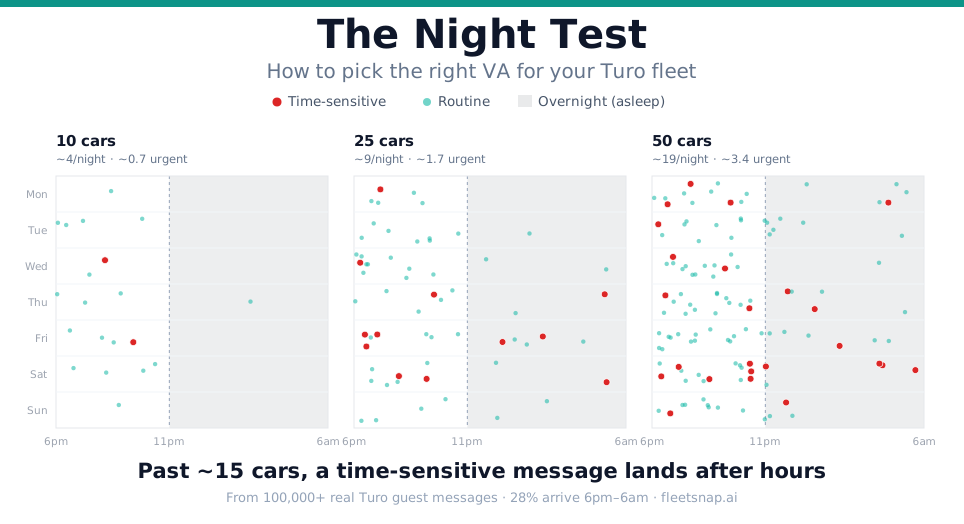
Under ~10 cars, an unwaitable after-hours message is occasional -- you can run the night yourself. Past ~15 cars, it's most nights. By ~30 cars, it's two a night on 87% of nights -- you're mathematically on call every evening, waking to a phone you can't ignore. That's where solo operators break: not daytime volume, the night.
The same week, drawn out -- three fleet sizes, seven nights each:
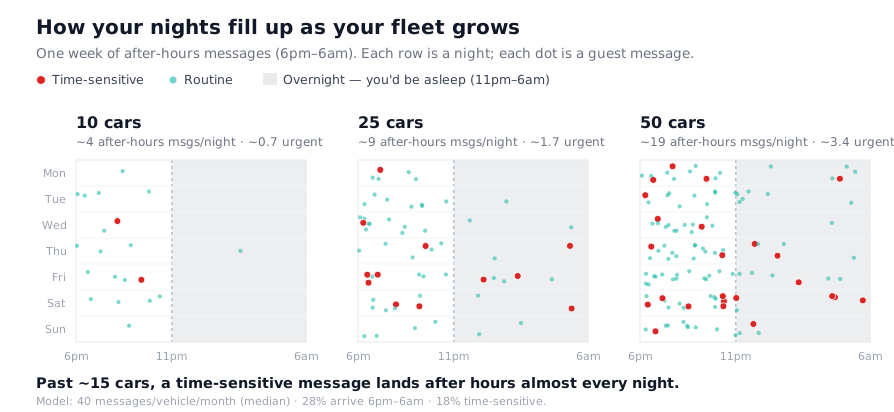
At 10 cars, the night is nearly empty. By 50, it's a wall -- and the red dots (trip changes, last-minute bookings, emergencies) land right through the hours you're asleep. You can't schedule around them, because they don't follow a schedule. This is the real reason "I'll just handle it myself" stops working -- and it's why coverage, not speed, is the thing to solve.
The framework: what to prioritize
There's no universal answer -- the right move depends on two things: how heavy your operation is (roughly, your car count) and how available you are to be on call. Find your quadrant, and it tells you what to do first, next, and what to skip:
What to prioritize (your operation × your availability)
| Lean op · ≤ ~15 cars | Heavy op · ~15+ cars, high use | |
|---|---|---|
| You can be on call | ① AI triage — then light systems. No VA yet; you're the coverage. | ① Systems (claims/maintenance) → ② AI triage → start delegating replies. |
| You're often away | ① AI triage → ② part-time VA for evenings + weekends. | ① AI triage + 24/7 coverage → ② systems for claims & handoffs. |
The pattern underneath all four quadrants is the same: triage first (it's cheap and works at any size), coverage next (because the night doesn't wait), and systems as the stakes rise (so claims and maintenance don't slip). What changes with your situation is only how soon you need each one.
The buyer's checklist
Whatever you choose, judge any Turo VA or VA service against these -- in roughly this priority order:
- Coverage, first. What hours and days are actually staffed? Does it include evenings, overnights, and weekends -- when 28% of the urgent load lands? A cheaper VA with the right coverage beats a premium one with a 9-5 gap.
- Triage method. How do they decide what's urgent? Is every message read and prioritized, or do they just work top-to-bottom until time runs out?
- Check-in / check-out. How do they handle guests at the car -- unlocks, key questions, late returns -- and the mid-afternoon and Monday-return spikes? This is where a slow reply strands a paying guest.
- Turo support & claims. When something goes wrong, do they actually work it through Turo -- open the claim, push the dispute, follow up -- or just message you and move on?
- Escalation path. When a genuine problem hits (damage, an accident, a vehicle issue), how does it reach you, how fast, and with what context?
- Speed on the right messages. Fast response on trip changes, bookings, check-in/out, and emergencies -- not a blanket SLA you're overpaying for on routine questions.
- Tracking & reporting. Do they log maintenance flags, open claims, and check-in/out exceptions -- and give you a clear view of volume, response times, and what's still open?
- Turo fluency. Do they understand how trip changes, extensions, claims, and the Turo app actually work -- or are you training them on your dime?
If a VA or service can't give straight answers on coverage, check-in/out, and how they work claims, the response-time guarantee on the brochure doesn't matter.
By the numbers
- 100,000+ guest messages across 700+ vehicles -- 20,000+ a month and growing
- 40 messages per vehicle per month (median); ~82% routine, 1 in 60 a genuine problem
- Most time-sensitive types: trip changes (58%) and new bookings (36%); routine questions just 11%
- 28% of messages -- and of urgent ones -- arrive 6pm-6am; weekends within 15-20% of weekdays
- A single full-time VA covers under 25% of the 168-hour week
- Past ~15 cars, a time-sensitive message lands after hours almost every night
- Urgent rate is flat as fleets scale: 1 in 6 from under 20 cars to 100+
The full aggregate dataset behind this guide is available as a machine-readable file (CC BY 4.0): turo-guest-messaging-2026.json.