
There is a specific moment most operators recognize.
You are at a dinner, or on vacation, or trying to watch something with your family, and you check your phone. Not because it buzzed. Because you have not checked it in forty minutes and something might have happened to one of the cars.
That is the trap, and it has very little to do with how many vehicles you own.
It is not about the number of cars
Operators at eight vehicles burn out. Operators at forty do not. The difference is almost never the fleet size and almost always the structure.
What exhausts people is not volume of work. It is the combination of three things: work that arrives unpredictably, work where you cannot tell in advance whether it matters, and work that nobody else can pick up.
A rental fleet produces all three at once, by design. Guest messages arrive on the guest's schedule. The urgent one is indistinguishable from the routine one until you read it. And if you are the only person who knows how everything works, there is nobody to hand it to.
That is a structural problem wearing the costume of a personal failing, which is why so many operators conclude they are just not cut out for it.
The specific mechanism: you cannot stop checking
Here is why the phone thing happens, mechanically.
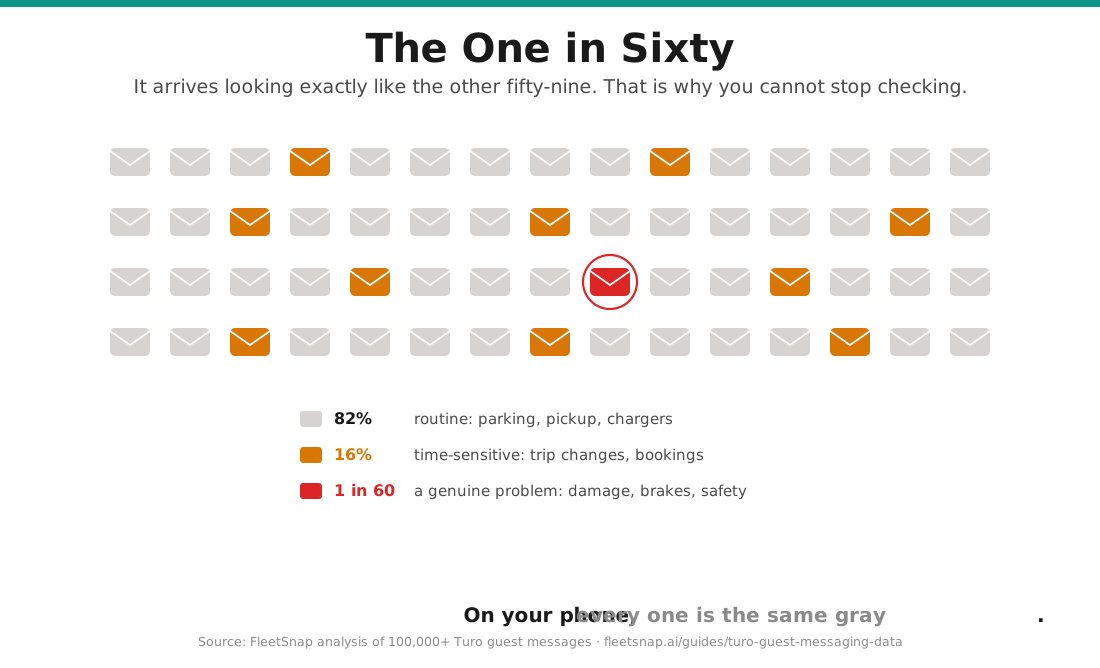
In our analysis of 100,000+ guest messages, roughly four in five were routine. About one in six needed a real answer. Around one in sixty was a genuine problem, the sort that becomes a repair bill or a damage dispute if nobody catches it.
The one in sixty arrives looking exactly like the other fifty-nine. There is no setting that separates a guest asking where to park from a guest saying the brakes feel soft.
So your brain does the only available thing. It treats every notification as potentially the important one, which means you can never fully put the phone down, which means you are never actually off.
You are not anxious because you are badly organized. You are anxious because you are running an unsolvable sorting problem in your head, continuously, and nobody told you it was unsolvable.
Understanding that is worth something on its own. It moves the problem from a character flaw to a design flaw, and design flaws have fixes.
What it costs, beyond the obvious
The personal cost is the part people talk about. There are three business costs that follow from it and get discussed much less.
You stop growing, and tell yourself it is a capital decision. The eleventh car stops being appealing. The reason given is usually financing. The real reason is that you cannot carry more load.
Your judgment degrades on exactly the decisions that compound. Pricing, which car to buy, which to sell. Those get squeezed into whatever attention is left after the urgent stuff, which is none.
You make the fleet unsellable. A business that only functions because one person holds it all in their head is a job, not an asset. If you ever want to sell or step back, the thing you built has no value without you in it.
What actually changes it
Three things, in order of how much they help. None of them is working harder.
Make the queue ranked instead of chronological. This is the single biggest change available, because it directly attacks the mechanism above. If you know the urgent thing will surface, you can stop treating every notification as potentially urgent. That is what gives you your evenings back, not doing the work faster.
Make the operation legible to someone else. Write down what happens at turnaround. Record where things are. The test is whether someone else could run a Tuesday without calling you. Until that is true you cannot take a week off and you cannot hire effectively.
Decide what you are not going to do. Not every guest message needs an immediate answer. Not every car needs same-day turnaround. Operators who survive this set boundaries deliberately rather than having them break on them.
Hiring does not fix this on its own
Worth saying because it is the most common attempted solution and it fails about half the time.
A VA working from an unranked inbox is a second person reading ninety messages in arrival order. You have bought capacity, not judgment. The one in sixty is as likely to be missed as before, and now it is missed by someone with less context than you, which means you still cannot stop checking.
Rank first, then hire. In that order the arrangement works, because you can genuinely hand over the routine eighty and trust that the exceptions reach you.
The same applies to a partner or a family member helping out. Without structure, you have shared the work and kept all of the anxiety.
The honest part
Some of this is not an operations problem.
If you are not sleeping, if the dread arrives before the phone does, if the thought of the fleet is heavy in a way that a better inbox would not touch, that is worth taking seriously on its own terms and worth talking to someone about. A ranked queue is a real fix for a real mechanism, and it is not a fix for everything, and anyone telling you software solves exhaustion is selling you something.
The reason to say that plainly in an article like this is that the gap between "my systems are bad" and "I am not okay" is one a lot of operators cross without noticing, and the advice for each is different.
Where FleetSnap fits, narrowly
One part of the above, not all of it.
FleetSnap's AI reads every incoming guest message and ranks it by urgency so the urgent ones surface first rather than arriving in whatever order they were sent. Your team still writes every reply and nothing goes out unattended.
That is the ranked queue described above, and it is the specific mechanism that lets people stop checking.
The maintenance agent flags issues from what guests mention in passing and logs them against the vehicle, which removes a second category of thing you were holding in your head. It flags and logs, it does not book repairs.
Role-based access means a VA or field person can work inside it without seeing everything, which is what makes handing over actually possible.
The earnings tool is free for three reports a month if you want somewhere low-commitment to start.
What it does not do: it will not clean your cars, it will not make your phone quiet on its own, and it is not a substitute for deciding what you are not going to do.