
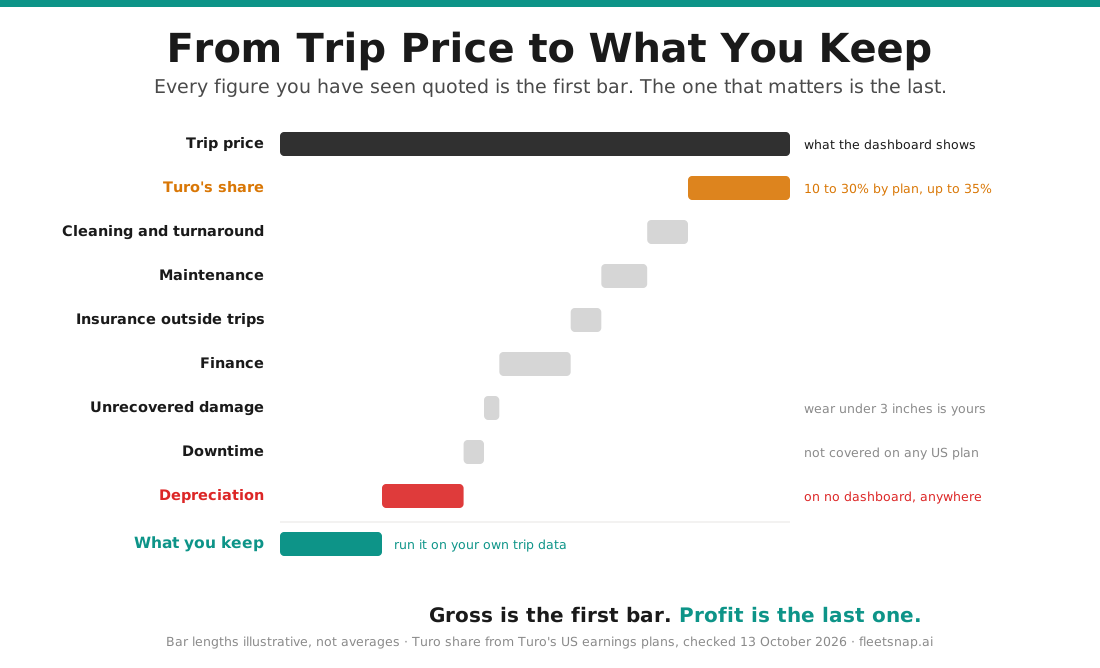
Every answer to this question is wrong in the same way. Someone quotes a monthly figure per car, the figure is gross revenue, and gross revenue is the number that tells you least about whether this business works.
Here is the version that is actually useful: the full stack of what comes out between the guest paying and you keeping anything, with the one verified number that matters most, and the step that almost nobody does.
Why every figure you have seen is gross
When a host says a car makes $1,200 a month, they almost always mean the trip revenue before the platform's share, before running costs, and before the vehicle quietly lost value sitting on the driveway.
That is not dishonesty. It is the number the dashboard shows, so it is the number people repeat.
The gap between it and what you keep is large enough that two operators quoting identical gross figures can be in completely different businesses, one profitable and one not, depending on their vehicle, their market and their plan.
The deduction stack, in order
1. The platform's share. This is the biggest single deduction and the one you can look up rather than estimate.
Turo runs three host earnings plans for US hosts, and the plan sets both what you keep and what you carry. In nine markets the share also moves with how far ahead the trip was booked, which Turo fees explained covers in full.
Turo earnings plans for US hosts
| Plan | You keep | Your damage responsibility |
|---|---|---|
| More peace of mind | 70% of the trip price | $250 |
| Balanced | 80% of the trip price | $1,500 |
| More earnings | 90% of the trip price | $2,750 |
So before anything else, somewhere between 10% and 30% of the headline figure is not yours, and up to 35% on a last-minute booking in a lead-time market.
2. Cleaning and turnaround. Whether you pay someone or do it yourself. If you do it yourself, cost it anyway, because your time is the constraint that decides how many cars you can run.
3. Maintenance. Higher than you expect, because a well-utilized rental vehicle can cover three times the mileage of a personal car in a year, which brings service intervals forward and wears consumables faster.
4. Insurance. Platform protection applies during trips. What covers the vehicle outside a trip, on a maintenance run or being repositioned, is a separate policy with a separate premium, and in some states commercial cover is required regardless.
5. Finance. If the car is financed, the payment is a fixed monthly cost against that specific vehicle, not a general business expense.
6. Unrecovered damage. Not the big claims, the small ones you absorbed. Turo does not reimburse wear and tear, which it defines as dings, dents, cracks or scratches to the exterior body that are 3 inches in diameter or less. Everything under that line is yours.
7. Downtime. Days the car could not earn. Turo's US earnings plans don't include loss of hosting income, and they don't include a replacement vehicle while yours is being repaired.
8. Depreciation. The one almost nobody subtracts, and frequently the largest cost of all.
The cost that never appears on any dashboard
A car that loses $3,000 of value in a year is costing you $250 a month whether or not you ever feel it. You feel it once, years later, when you sell.
Depreciation does not show up on your platform statement, it does not arrive as an invoice, and nothing prompts you to think about it. Which is why fleets routinely run for two or three years on the belief that they are profitable, and discover at resale that one or two vehicles were consuming the margin the whole time.
It is also why the most booked car is frequently not the most profitable one. High-demand vehicles tend to be newer and more desirable, and both of those things mean faster value loss.
The arithmetic, so you can run your own
Net profit per vehicle per month equals:
Daily rate, times utilized days, minus the platform's share at your plan, minus cleaning and turnaround, minus maintenance amortized across the year, minus insurance, minus finance, minus unrecovered damage, minus annual depreciation divided by twelve.
Anything that stops before that last term is not a profit calculation. It is a revenue calculation with some costs taken off.
Two errors to avoid when you run it. Use your average utilization, not your best month, because overestimating utilization is the single biggest source of error in first-car projections. And use the plan you are actually on, not the one with the best headline percentage.
What this means for the question behind the question
Most people asking how much Turo hosts make are really asking one of two things.
Is this worth starting? That depends almost entirely on your cost of capital, your market and the specific vehicle, and it is answerable in an afternoon with real numbers rather than in a blog post with averages. Model one car properly before you buy it.
How many cars until this replaces my income? Take your genuine net profit per car per month, including depreciation, and divide your target income by it. The answer is usually a larger number than people expect, because they started from the gross figure.
The reason the second question gets answered badly is that almost nobody knows their real per-car net, which makes the division impossible and the plan a guess.
Getting your own number
This is the specific gap FleetSnap's earnings tool was built for. You upload your trip export and it produces true profit per vehicle after platform fees, running costs and estimated depreciation, which is the calculation above done from your actual data rather than from estimates.
Three reports a month are free, with no limit on fleet size, and plenty of operators use nothing else. Most run it once and change their mind about which car to buy next, or which one to sell.
Beyond the numbers, the wider product handles the operational side that decides whether a profitable car stays profitable. The AI reads and ranks every guest message so the urgent ones surface first, with your team still writing every reply. The maintenance agent flags issues out of what guests mention in passing, which is where most expensive repairs announce themselves weeks in advance. Damage is documented against the vehicle and trip and tracked through to recovery rather than quietly written off. Check-in and checkout capture is rolling out to first operators now.