Turo Insurance for Hosts: What the Protection Plans Actually Cover
How Turo host protection plans work, what commercial coverage you may still need, and the gaps that catch operators out at scale.
 By The FleetSnap Team·7 min read
In this guide
This article explains how host protection is structured. It is not insurance advice, and coverage requirements vary by state. Speak to a licensed broker before making decisions about your fleet.
Insurance is the line item most likely to turn a profitable fleet into an unprofitable one, and it is the one most operators research last, usually after something has already gone wrong.
The confusion is structural rather than anyone's fault. "Turo insurance" sounds like one thing. It is actually three separate questions with three different answers, and the gap between them is where operators get caught.
How Turo protection plans are structured
Turo offers hosts a choice of protection tiers. The trade is consistent across them: the more protection you take, the smaller your share of each trip's revenue. Take less protection, keep more of the trip, carry more risk yourself.
Two things matter more than the tier names.
Protection applies during a trip. The vehicle's status outside a trip, between bookings, during a maintenance run, while being repositioned, is a separate question. This is the single most common gap.
Protection is not the same as insurance. The structure and what underlies it varies by jurisdiction, and whether it satisfies your state's requirements for a vehicle being rented commercially is a question for a broker, not a blog.
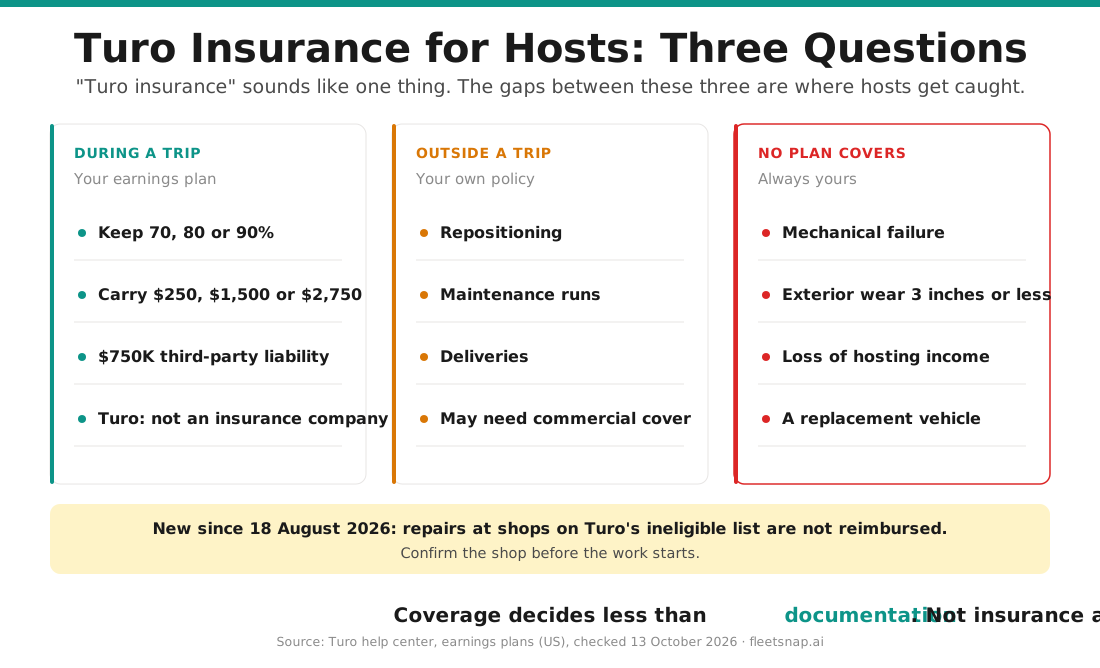
Turo calls these earnings plans, and there are three for US hosts. The figures below are from Turo's help center, checked 13 October 2026.
| Plan | You keep | Your damage responsibility |
|---|---|---|
| More peace of mind | 70% of the trip price | $250 |
| Balanced | 80% of the trip price | $1,500 |
| More earnings | 90% of the trip price | $2,750 |
All three include third-party liability up to $750,000 (lower in New York), which covers bodily injury and property damage to other people and explicitly does not cover your own car. Above your damage responsibility, Turo reimburses eligible repairs up to the actual cash value of the vehicle or $200,000, whichever is lower.
In nine markets the host share is adjusted by booking lead time rather than fixed. Austin, Dallas, Detroit, Las Vegas, Maui, Philadelphia, Phoenix, San Diego and Seattle run ranges of 65 to 80% on More peace of mind, 75 to 90% on Balanced and 85 to 100% on More earnings, with trips booked further ahead generally earning a higher share. The full table is in Turo fees explained.
On the second point above, you do not have to take anyone's word for it. Turo's own page states that Turo is not an insurance company.
What the plans cover and what they do not
Broadly, the areas where hosts most often discover a gap:
Mechanical failure is generally not a damage claim. A transmission that fails during a trip is usually your problem, not the guest's and not the platform's.
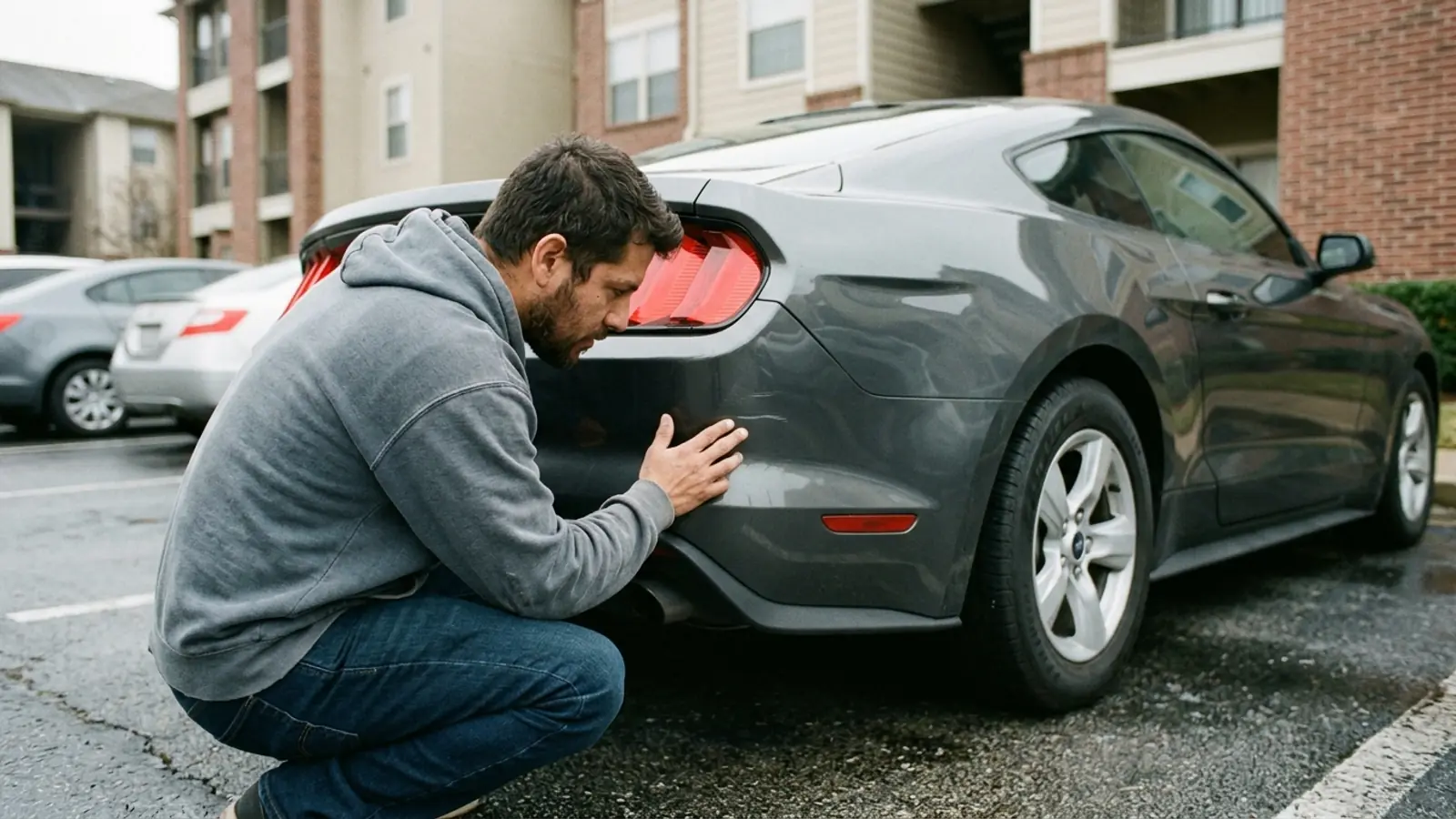
Wear and tear is not reimbursed, and Turo defines exterior wear and tear precisely: dings, dents, cracks or scratches to the exterior body that are 3 inches in diameter or less. That 3 inch line is the most useful number in this article, because it tells you exactly what you will be absorbing yourself and exactly what threshold your handover documentation needs to clear to be worth filing.
Loss of hosting income is not included. Not reduced, not tier-dependent, not included. The days your vehicle cannot earn while it is being repaired are your cost on every plan. For most operators that exceeds the repair bill itself.
A replacement vehicle while yours is being repaired is not included either.
Your damage responsibility, which is $250, $1,500 or $2,750 depending on the plan, and is the number people forget when they compare the 70, 80 and 90% shares.
Covered events are collisions and most comprehensive events, which Turo lists as including theft, fire, animal impacts, vandalism and falling objects, subject to its terms and exclusions.
All of the above from Turo's help center, checked 13 October 2026. Turo revises these plans, so confirm the current terms in your host account.
When you need commercial coverage as well
Three situations where platform protection alone is commonly insufficient.
Your state requires it. Some states have specific requirements for vehicles used commercially that platform protection does not satisfy on its own.
You have a financed vehicle. Lenders typically require comprehensive coverage, and a personal policy may be void if the vehicle is being rented commercially. This catches a lot of first-time operators.
The vehicle is in use outside trips. Repositioning, maintenance runs, deliveries. If something happens while the car is not on a trip, platform protection generally does not apply.
Get quotes before you buy the vehicle rather than after. In some markets the commercial premium alone will tell you whether the economics work, and that is much cheaper to learn before you own the car. How to start a car rental business puts that quote in the first two weeks for this reason.
Protection tiers and what each costs you in earnings
The comparison people make is between the 70, 80 and 90% shares. The comparison that matters is the effective cost across a year, including what you absorbed because your plan did not cover it.
Run the arithmetic properly. Moving from Balanced to More earnings gains you 10 percentage points of every trip and raises your per-incident exposure from $1,500 to $2,750. On a fleet turning over enough trips, that 10 points is large. The question is whether the extra $1,250 per incident, multiplied by how often you actually have incidents, eats it.
A lower-protection tier keeps more of every trip and occasionally costs you a repair that erases a quarter of the saving. Whether that is a good trade depends almost entirely on fleet size, because self-insuring works across twenty vehicles in a way it cannot across two. With two cars, one bad event is your whole year. With twenty, it is a cost of doing business.
The practical approach: work out your annual saving from a lower tier, then ask whether you could absorb one uncovered incident without it hurting. If not, the higher tier is cheaper than it looks.
The gaps that catch bigger fleets
Four things that only become problems at scale.
The non-trip window grows. More vehicles means more repositioning, more maintenance runs, more time with cars in motion but not on a trip.
Loss of use compounds. At two cars, a vehicle off the road for two weeks is annoying. At twenty, with several in repair simultaneously, it is a material revenue loss that the plans do not compensate.
Claims administration becomes a job. Multiple open claims across multiple vehicles and possibly multiple platforms, each with its own window. On Turo, damage has to be reported no more than 24 hours after the trip ends. Claims get dropped not because they would have failed but because nobody was tracking them.
Damage responsibility accumulates. Several small claims in a month, each under or near your damage responsibility, can cost more in aggregate than one large claim that was covered.
The part you actually control
You do not control the protection terms. You control the documentation, and documentation decides more claims than coverage does.
An operator with consistent pre-trip and post-trip records recovers most recoverable damage. An operator without them recovers little, on any tier, on any platform. The tier you choose matters less than whether you can prove the vehicle's condition at handover. Turo also deems photos without date, time and location metadata invalid, so the capture routine matters as much as the photos.
This is covered properly in how to file a Turo damage claim and Turo check-in and checkout.
How FleetSnap reduces what you claim for
Two of the four gaps above are operational, and that is where FleetSnap sits.
Claims administration. Damage is documented against the specific vehicle and trip, and claims are tracked through to recovery rather than relying on memory across a busy month. Open claims stay visible. Most unrecovered damage is lost to being forgotten rather than refused.
Mechanical failure, which protection generally does not cover. This is the expensive category and it is also the most preventable, because the failures usually announce themselves weeks in advance in a message from a guest. FleetSnap's maintenance agent reads guest messages and flags issues from what guests mention without being asked, logging them against the vehicle. It flags and records. It does not book the repair or decide what to do, but it means the warning reached you.
Questions hosts ask
Does Turo provide insurance for hosts?
Turo offers three earnings plans, where the plan you choose sets both your share of the trip price, 70, 80 or 90%, and your damage responsibility, $250, $1,500 or $2,750. Turo states that it is not an insurance company, and whether its protection satisfies your state's requirements for commercial use is a separate question for a broker.
Do I need commercial insurance to host on Turo?
Frequently yes, particularly if the vehicle is financed, if your state requires it, or if the vehicle is driven outside of trips. Get quotes before buying the vehicle.
Does Turo protection cover mechanical failure?
No. Protection covers collisions and comprehensive events such as theft, fire, vandalism and animal impacts. Mechanical failure is the host's cost, which is why catching problems early matters more here than coverage does.
Which Turo protection tier should I choose?
Work out the annual saving from a lower tier and ask whether you could absorb one uncovered incident. Self-insuring works better across larger fleets than small ones.
What is loss of use and is it covered?
The days a vehicle cannot earn while being repaired. Turo's US earnings plans don't include loss of hosting income or a replacement vehicle. It is frequently the largest uncompensated cost of a damage event.