
Turo Mileage Limits: How to Set Them and What Overages Really Cost
How Turo mileage limits work, what to set them to by vehicle type, and how overage charges are calculated and disputed.
 By The FleetSnap Team·7 min read

In this guide
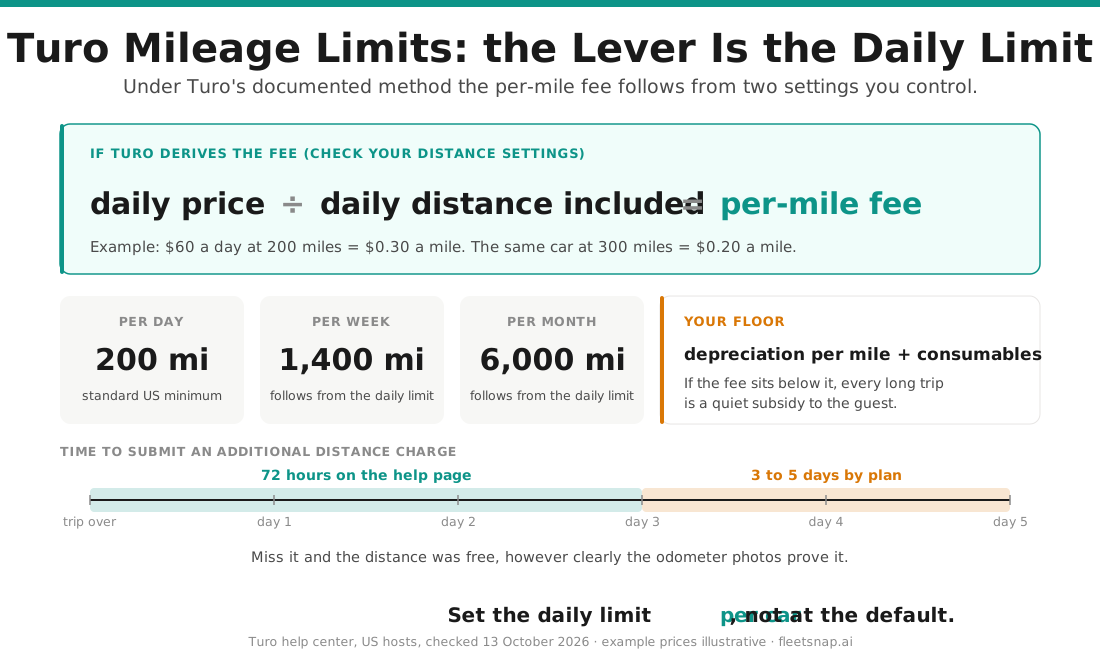
Short answer: Turo hosts either offer unlimited distance or set a daily distance limit, with a per-mile fee for additional distance beyond what the trip includes. For most US vehicles the minimum daily limit is 200 miles. The lever that matters most is that daily limit rather than the fee itself, because Turo's documented method derives the additional distance fee from your daily price divided by your daily distance included. Tighten the limit and the per-mile rate rises with it. Turo's help center gives you 72 hours from the end of the trip to submit an additional distance charge, and its earnings plans page lists 3 to 5 days depending on your plan.
The detail is below.
How Turo mileage limits work
You choose between offering unlimited distance or setting a daily distance limit on the vehicle. This is the detail most guides get wrong. The limit is daily, and the distance included in a given trip follows from it.
The longer allowances are calculated from the daily figure rather than set separately. A vehicle at 200 miles a day includes 1,400 miles across a week and 6,000 across a month.
Minimums depend on the vehicle class. For most standard vehicles in the US the floor is 200 miles a day. Deluxe and Super Deluxe class vehicles can go lower, to 100 or 150 miles, and 75 miles for Super Deluxe. In Canada the standard floor is 300 km a day. Monthly rentals work differently again, with lower caps, which is covered in Turo monthly rentals.
The part worth checking yourself: Turo originally let hosts type in their own additional distance fee, and in August 2020 moved to calculating it at booking by dividing your daily price by your daily distance included. We could not confirm from Turo's live pages which applies today, so check the distance settings on one of your vehicles before you plan around it.
If the derived method is still in force, it has a consequence most hosts miss. Your per-mile rate is not an independent setting, it is the output of two things you do control. Raising your daily price raises it. Lowering your daily distance limit raises it. Which means a generous distance limit does not just give away miles, it also cheapens every mile beyond the limit.
What to set, by vehicle type and trip length
The principle: the limit should reflect what distance costs you on that specific vehicle.
Economy and compact vehicles. Cheap per mile to run, and the depreciation impact of mileage is moderate. These tolerate generous limits, and a generous limit is a genuine competitive advantage on a listing in a crowded segment.
Mid-range sedans and crossovers. Moderate limits. This is the band where most hosts default to whatever Turo suggests and never revisit it, which is usually fine but rarely optimal.
Premium and luxury vehicles. Tighter limits, higher overage rates. Mileage hits resale value hardest on these, and the service intervals are expensive. A luxury vehicle with an unlimited mileage listing is a vehicle whose resale you are donating to your guests.
Electric vehicles. A separate consideration, because mileage drives battery cycles and battery condition is a large component of EV resale value. Tighter than you would set on an equivalent combustion car.
Trucks and vans. Often rented for a specific job with predictable distance. Moderate limits with a clearly stated overage rate work well, because the guest usually knows roughly what they need.
How overage charges are calculated
Additional distance is the mileage driven beyond what the trip included, multiplied by the per-mile fee, determined by the odometer readings recorded at the start and end of the trip.
Turo's help center gives you 72 hours from the end of the trip to submit the charge, and its earnings plans page lists a longer invoice window on the lower-share plans: 3 days on More earnings, 4 on Balanced, 5 on More peace of mind. Miss it and the distance was free, however clearly you can prove it afterwards.
Which makes the odometer photos the whole ballgame. An additional distance charge without a clear, timestamped odometer reading at both ends is one you will lose if disputed.
This is the same documentation discipline that decides damage claims, and most hosts capture the odometer carefully at pickup and casually at return, which is precisely backwards. The return reading is the one that gets challenged. The full handover sequence is in Turo check-in and checkout.
Disputing an overage that was not applied
If distance was driven beyond the limit and no charge appeared, the usual causes are a missing or unclear odometer reading at one end, a reading submitted outside the platform's window, or an ambiguity the platform resolved in the guest's favor.
What to do: submit clear odometer images from both ends of the trip, inside the window, with the trip clearly identified.
What to do next time: capture the odometer as a standard step at both ends, every trip, in the same way. Consistency is what makes it defensible.
The hidden cost: depreciation per mile
This is the part that changes how you think about the limit.
Every mile driven reduces what the vehicle is worth. For a typical vehicle that cost is meaningful, and for a premium vehicle it can be several times higher. A trip that runs 400 miles over your limit has cost you real resale value whether or not you collected an overage charge.
So the number you need is your real cost per mile. Take the vehicle's annual depreciation, divide by the miles you expect to put on it in a year, and add consumables. That is the floor your additional distance fee has to clear.
Then compare it to what the platform is actually charging on your behalf. If the fee is derived from your daily price divided by your daily distance included, you can work out your own rate in ten seconds, and plenty of hosts find it sits below their true cost per mile. That is a subsidy running quietly in the guest's favor on every trip that goes long.
The fix in that case is not the fee field. It is the daily distance limit, and to a lesser extent the daily price. A vehicle at a generous limit and a modest daily rate produces the lowest per-mile recovery of any configuration you could have chosen, which is the opposite of what most hosts think they are doing when they advertise generous mileage.
Unlimited mileage, and when it makes sense
It makes sense in a narrow set of cases. Older high-mileage vehicles where depreciation is already close to flat. Very competitive markets where it is the differentiator that wins bookings. Long-term rentals priced to absorb it.
It does not make sense on anything newer, anything premium, or anything electric, and it is one of the more common ways operators lose money without noticing, because the loss shows up on the resale rather than on the monthly statement. Which cars depreciate fastest in the first place is covered in best cars for Turo.
Seeing what mileage is actually costing you
The reason this gets set badly is that the cost is invisible. Your platform dashboard shows revenue. It never shows the value the vehicle lost while earning it.
FleetSnap's earnings tool calculates true profit per vehicle after platform fees, running costs and estimated depreciation, which makes the mileage cost visible for the first time on most fleets. It is free for three reports a month at any fleet size. How to read your fleet profit shows where the depreciation estimate sits in the report.
Questions hosts ask
What is a good mileage limit for Turo?
It depends on the vehicle, and the floor for most standard US vehicles is 200 miles a day. Economy cars tolerate generous limits. Premium, luxury and electric vehicles should sit at the minimum, because mileage hits their resale hardest and a tighter limit also raises what you recover per additional mile.
How much should I charge for mileage overage?
Your floor is the vehicle's depreciation per mile plus consumables. Note that the fee may not be a free-text field. Turo's documented method derives it from your daily price divided by your daily distance included, so in practice you influence it through those two settings rather than setting it outright. Check your vehicle's distance settings to see which applies to your account.
Can I offer unlimited mileage on Turo?
Yes, and it is usually only sensible on older high-mileage vehicles or in very competitive markets. On newer or premium vehicles it transfers resale value to the guest.
Why was my mileage overage not charged?
Most commonly a missing or unclear odometer reading at one end of the trip, or a submission made after the window closed. Turo's help center says 72 hours, and its earnings plans page lists 3 to 5 days depending on your plan. A late submission fails regardless of how good your evidence is.
Does mileage affect my car's value as a rental?
Substantially, and it is the cost most hosts never subtract. Run your fleet through FleetSnap's free earnings tool to see it.