
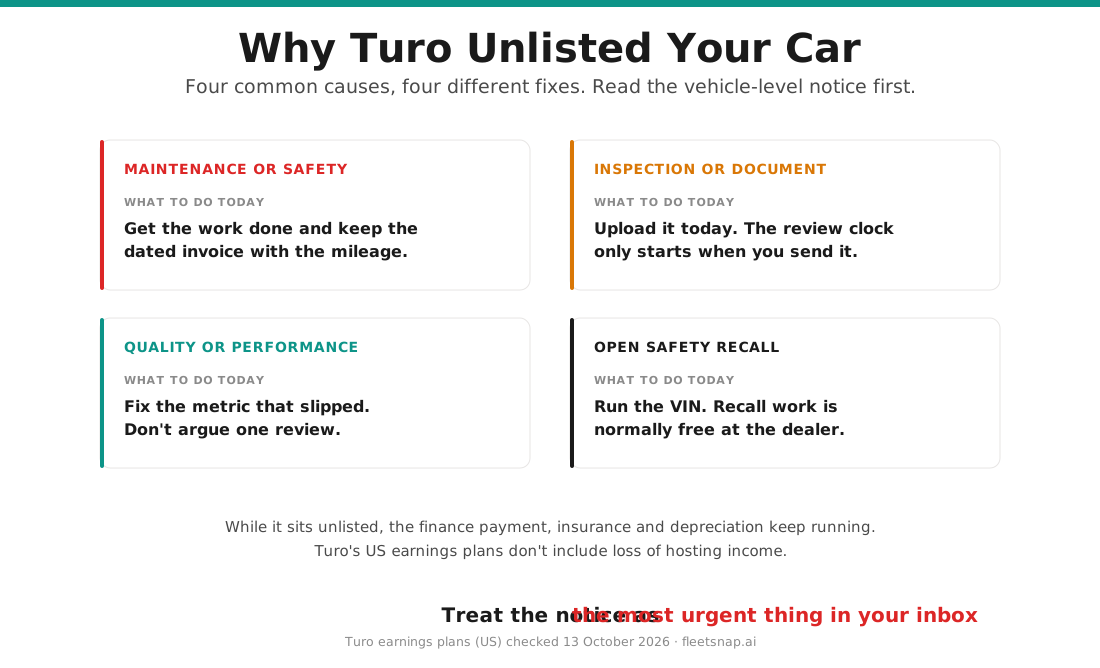
Short answer: a Turo vehicle usually comes off the platform for one of four reasons: an unresolved maintenance or safety requirement, an outstanding inspection or document, a performance or quality standard the listing has fallen below, or an open safety recall. In most cases the vehicle is not removed permanently, it is suspended pending something you need to supply. Find out which category you are in first, because the fix is different for each, and the thing that costs you money is the days spent guessing.
The detail is below.
First, check which kind of unlisting this is
Before anything else, open your host account and read the notice attached to the vehicle rather than the general one on your dashboard. The vehicle-level message is what tells you the actual requirement.
The distinction that matters: a vehicle you have unlisted or snoozed yourself, a vehicle Turo has suspended pending an action, and a vehicle removed for eligibility reasons. The first is a settings problem. The second is a documentation problem and is the common case. The third is the serious one.
The four common causes
An unresolved maintenance or safety requirement. The most frequent cause on fleets, and usually the consequence of something logged and then forgotten rather than something ignored. Turo sets vehicle maintenance and safety standards, and inspection requirements vary by market and, in the US, by state.
An outstanding inspection or document. Inspection reports, servicing confirmation, registration or similar, depending on your market. Entirely administrative, entirely solvable, and the category where hosts lose the most days to inaction because the notice looks less urgent than it is.
A quality or performance standard. Cancellations, cleanliness and maintenance ratings and review scores all feed into whether a listing stays healthy. This one rarely arrives without warning, and the warning usually came as a metric trending down over weeks.
An open safety recall. Manufacturer recalls are a genuine safety matter and not a formality. A vehicle with an open recall is a liability question as well as a listing question, and it is worth checking your whole fleet rather than only the car that triggered the notice.
What to do today
In this order, because the order saves days.
Read the vehicle-level notice, not the dashboard summary. It names the requirement. Everything else is guesswork until you have done this.
If it is documentation, send it today rather than tomorrow. Review takes as long as it takes, so the only variable you control is when the clock starts. A vehicle sitting unlisted for three days because nobody uploaded a PDF is three days of finance payment against zero revenue.
If it is maintenance, get the work done and keep the paperwork. The invoice with the date, mileage and what was done is the thing that resolves the case. A verbal confirmation from a repair shop is not.
If it is a recall, check it properly. Recall work is normally free at a franchised dealer. Run the VIN rather than assuming. Our fleet recall check guide covers the routine.
If it is performance, do not argue the individual case. Fix the metric. Appeals about a specific review are rarely where the leverage is.
Reply once, clearly, and stop. Repeated messages do not accelerate a queue, and a thread with nine host messages in it is harder to action than one with a complete answer.
What it is costing you while it sits
Worth being blunt, because it changes how urgently people treat the notice.
An unlisted vehicle still costs you the finance payment, the insurance and the depreciation. It just stops earning. On a typical financed vehicle that is a real daily number, and it accrues from the moment the listing goes down, not from the moment you get around to looking at it.
There is no compensation for this. Turo's US earnings plans don't include loss of hosting income, so downtime for any reason is entirely your cost.
That is the whole argument for treating an unlisting notice as the most urgent thing in your inbox on the day it arrives.
How to stop it happening again
Three things, and the third is the one that actually works.
Keep per-vehicle records rather than fleet records. Service history, inspection dates, documents, all against the specific car with dates and mileage. When a requirement lands, you either have the evidence in one minute or you have a week of reconstruction.
Calendar the recurring requirements. Anything annual should exist in a calendar before it exists in a notice. Inspections, servicing, registration. The administrative causes are the easiest to prevent and the most common.
Catch the mechanical problems early, which means reading what guests say. Most maintenance issues that end in a suspension were mentioned by a guest weeks earlier. A grinding noise, a warning light, a pull to one side, raised once in a message about something else and answered with information about parking.
That third one is not a discipline problem. At ten vehicles and up, the urgent message genuinely is indistinguishable from the routine one until someone reads it, and reading everything stops being possible.
Where FleetSnap fits
This is the problem FleetSnap was built for, so the fit is direct rather than stretched.
The AI reads every incoming guest message and ranks it by urgency, so the one mentioning a noise surfaces above the forty about parking. Your team still writes every reply and nothing goes out unattended.
The maintenance agent takes what guests mention in passing and logs it against the specific vehicle, so the warning becomes a record rather than a sentence that scrolled past. It flags and logs. It does not book the repair or decide what to do about it.
Open issues stay visible as a list, which is the part that prevents the suspension, because known problems are usually lost to a busy week rather than to ignorance.
On early FleetSnap fleets, the share of vehicles with an open maintenance issue fell from roughly 15% to under 4%.
Check-in and checkout capture is rolling out to first operators now.
The honest limit: FleetSnap does not file anything with Turo for you and does not resolve a suspension. What it does is make the mechanical causes much less likely to reach that point.