
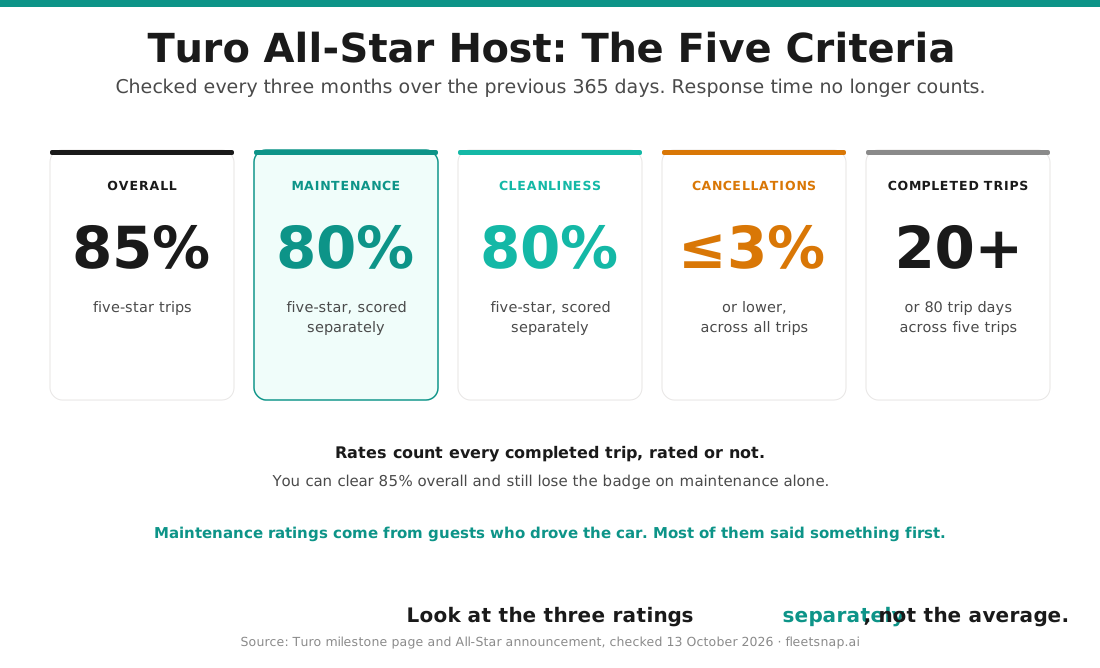
Short answer: All-Star Host status requires five things. Five-star overall ratings on at least 85% of completed trips, five-star maintenance ratings on at least 80%, five-star cleanliness ratings on at least 80%, a cancellation rate of 3% or lower, and at least 20 completed trips (or 80 trip days across five trips). Turo checks every three months, looking back over the previous 365 days.
Criteria as published by Turo, checked 12 October 2026. Verify current requirements in the Performance tab of your host account, because they have been revised before.
The five criteria, and which one actually catches people
Overall five-star rate, 85%. The headline number. Fewer than one in seven trips can come in below five stars.
Maintenance rating, 80% five star. A separate criterion with its own threshold, and the one most operators do not realize is being scored independently.
Cleanliness rating, 80% five star. Also separate. Turnaround quality is measured whether or not you think of it as a measured thing.
Cancellation rate, 3% or lower. Across all trips in the previous 365 days. On a fleet doing 400 trips a year, that is twelve cancellations. It sounds generous until a vehicle goes off the road unexpectedly and you cancel six bookings in a week.
At least 20 completed trips, or 80 trip days across five trips. The only one that is purely a volume gate, and the only one you cannot fail through quality.
One thing worth knowing: the rates are measured across all completed trips, with and without ratings, so a guest who never rated the trip still counts. And acceptance rate and response rate are no longer part of the criteria, since Turo now books all trips instantly. If you are working from older advice telling you to optimize response time for All-Star, that advice is out of date.
Why the three separate ratings change how you should think about this
Most hosts treat their rating as one number and try to make guests happy in general. The structure says something more specific: you can be well above the overall threshold and still lose status on maintenance or cleanliness alone.
That is useful, because it tells you where to look. A host sitting at 90% overall and 76% on maintenance does not have a guest satisfaction problem. They have a vehicle condition problem, and no amount of better communication fixes it.
So the first diagnostic is to look at the three rates separately rather than at the average. They usually diverge, and the gap tells you what to work on.
The cancellation criterion is an operations problem in disguise
Three percent is the tightest-looking number on the list and it is the one most exposed to things outside your control.
Host cancellations mostly happen for one of three reasons. A vehicle became unavailable because something broke. A vehicle became unavailable because something administrative lapsed, such as an inspection or document. Or a double booking across channels.
None of those are judgment failures. All three are systems failures, and all three are preventable in ways that have nothing to do with willpower.
The second one is the most annoying, because an administrative lapse that unlists a vehicle can cost you a run of cancellations in a week and put your 365 day rate out of range for the next year. We cover that in why Turo unlisted your car.
Where the maintenance rating actually comes from
This is worth sitting with, because it connects two things most operators treat separately.
Your maintenance rating comes from guests, who are rating the condition of a car they drove for three days. They notice the things that were wrong while driving. A noise, a warning light, a pull, a soft pedal, a smell, a vibration at speed.
Those are the same things they mention in messages, usually in passing, usually weeks before you would have found them yourself.
So the guest who mentions a grinding noise on day two and gets a reply about parking is very likely the guest who rates maintenance at four stars on day four. The message and the rating are the same event seen twice, and you got the warning first.
Which means your maintenance rating is substantially a measure of how well you read your inbox, and only partly a measure of how well you maintain cars.
What to work on first
In order of return.
Separate the three rates and find the weakest. Everything else is guesswork until you know whether this is a condition problem, a cleaning problem or a general experience problem.
If it is maintenance, build a signal path from guest messages. The warnings exist already. The question is only whether anyone reads them in time to act before the next guest gets the same car.
If it is cleanliness, fix the turnaround constraint rather than the standard. Cleanliness ratings fall when turnarounds are compressed, not when people forget cleanliness matters. The root cause is usually back-to-back bookings with no slack.
If it is cancellations, audit why each one happened. Group them into mechanical, administrative and double booking. Each has a different and fairly boring fix.
Do not chase individual reviews. Appeals on a single rating are rarely where the leverage is, and the time is better spent on whichever rate is dragging.
Is it worth it
Honestly, the status itself is a signal rather than a mechanism. The badge does not route bookings to you the way some hosts assume.
The reason to pursue it is that the criteria are a reasonable proxy for a fleet that is running properly. A host clearing 85% overall, 80% on maintenance and cleanliness, and under 3% cancellations is a host whose operations are working. The status is the symptom.
It is also a step toward Power Host status, so for operators building toward that, it matters as a stage rather than as a destination.
The practical read: do not optimize for the badge. Optimize for the three things it measures, and the badge is a side effect.
Where FleetSnap fits
The connection here is narrow and specific rather than general.
Two of the five criteria, the maintenance rating and the cancellation rate, are substantially downstream of whether mechanical problems get caught early. FleetSnap's AI reads every incoming guest message and ranks it by urgency so the one mentioning a noise surfaces above the forty about parking. Your team still writes every reply and nothing goes out unattended.
The maintenance agent takes what guests mention in passing and logs it against the specific vehicle, so the warning becomes a record rather than a sentence that scrolled past. It flags and logs. It does not book the repair or decide what to do about it.
On early FleetSnap fleets, the share of vehicles with an open maintenance issue fell from roughly 15% to under 4%.
What it does not do: it will not improve your cleanliness rating, it does not manage your calendar, and it does not interact with Turo's status system. Check-in and checkout capture is rolling out to first operators now.