
Most maintenance advice assumes you own one car and drive it yourself. Service it on schedule, listen for noises, book it in when something feels wrong.
A rental fleet breaks all three assumptions. You are not the one driving, so you never hear the noise. The schedule arrives three times faster than it would on a personal car. And the person who does hear the noise has no reason to tell you, and often mentions it in passing in a message about something else entirely.
That gap, between a problem existing and you knowing about it, is what maintenance tracking is actually for. Not the calendar. The calendar is the easy part.
Why rental vehicles break the normal schedule
A personal car does somewhere around 12,000 miles a year. A well-utilized rental vehicle can do three times that, which means the 30,000 mile service arrives in year one rather than year three.
That compression has three consequences most new operators learn the expensive way.
Intervals arrive out of sequence with your planning. You budgeted for a service next spring. It is due in six weeks.
Wear items fail faster than scheduled parts. Tires, brakes and suspension components take a harder life in rental use than mileage alone predicts, because a large share of guests drive a car they do not own in a way they would not drive their own.
The cost per month of ownership is higher than the schedule suggests. If you are modeling maintenance at personal-car rates, your per-vehicle profit figure is wrong, and it is wrong in the direction that makes you buy another car.
The three sources of maintenance signal, and the one nobody uses
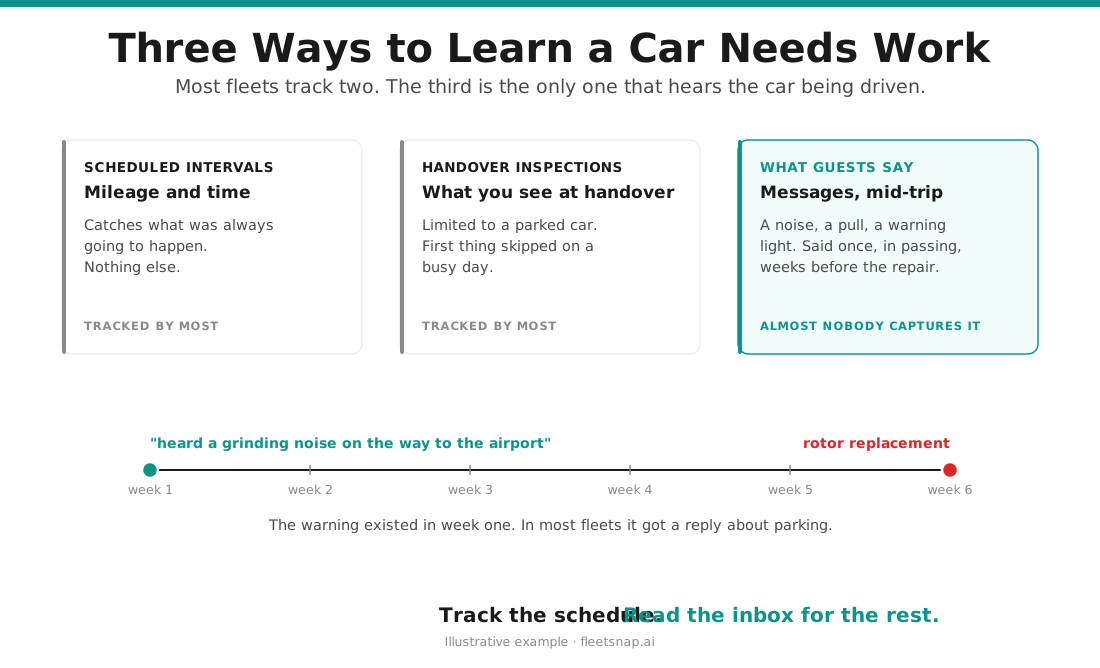
Every fleet has three ways of learning that a vehicle needs attention. Most use two.
Scheduled intervals. Mileage and time based. Predictable, plannable, and the only one most operators track. It catches what was always going to happen and nothing else.
Inspections. Whatever you or your team see at handover. Useful, limited by what is visible standing next to a parked car, and the first thing that gets skipped on a busy day.
What guests say. This is the one almost nobody captures, and it is the most valuable of the three, because it is the only source that reports how the car behaves while it is being driven.
A guest will mention a noise on the highway, a pull to one side, a warning light that came on and went off again, a smell of burning after a long hill. They will mention it once, in the middle of a message about where to leave the keys, and they will not follow up because it is not their car and it did not stop them getting where they were going.
That message is the single earliest warning you will ever get about a mechanical problem, and in most fleets it goes into an inbox and is answered with information about parking.
What an expensive repair looks like before it is expensive
The pattern is consistent enough to plan around.
A brake issue announces itself as a guest mentioning a grinding sound, weeks before it becomes a rotor replacement. A transmission problem announces itself as a guest saying the car hesitated pulling away. A cooling system failure announces itself as a guest mentioning the temperature gauge did something odd on a long drive.
None of those guests filed a report. All of them said something.
The difference between a fleet with a high surprise rate and one with a low surprise rate is almost never diligence about schedules. It is whether anyone was reading closely enough to catch the sentence.
What a maintenance tracking system actually needs
Four things, in order of how much they matter.
Per-vehicle history, not fleet-level records. The question you need to answer is what has been done to this car and when, in under a minute, standing in a repair shop. Fleet-level spreadsheets cannot answer that and quietly stop being updated.
Capture from the sources you already have. Anything requiring new manual entry will be abandoned within two months. The system has to pull from trips you already run, messages that already arrive and photos your team already takes.
A signal path from guest messages. See above. If guest communication and maintenance records are two separate systems that never speak, the most valuable signal in your operation is being discarded daily.
Visibility of what is open. Not what is scheduled. What is outstanding right now, on which vehicle, and how long it has been sitting there. Most maintenance that becomes expensive was known about and then lost in a busy week.
The listing risk
The commercial reason this matters more on a rental fleet than a personal car is that a vehicle with an unresolved maintenance or safety issue is a vehicle at risk of coming off the platform, and a vehicle that is not listed earns nothing while still costing you the finance payment, the insurance and the depreciation.
Turo sets vehicle maintenance and safety standards, and inspection requirements vary by market and, in the US, by state. The exact current requirements, what triggers an unlisting and what is needed to relist are the sort of thing that changes, so check them in your host dashboard rather than relying on any article, including this one.
We cover the relisting side in why Turo unlisted your car.
Building the habit before you need the system
At one to five vehicles you can do this with a shared document and discipline. What matters is the habit rather than the tooling.
Record every service against the specific vehicle with the date and mileage. Note anything a guest mentions, however minor, against the vehicle, on the day it is mentioned. Review the open list weekly rather than when something breaks.
That last one is the whole discipline. Fleets that review a list of open issues on a fixed day have low surprise rates. Fleets that respond to problems as they surface have high ones, because the surfacing is the expensive event.
Past roughly ten to fifteen vehicles the volume defeats the document, mostly because the guest message channel generates more signal than any person can sift while also running the business.
How FleetSnap handles the signal
FleetSnap was built around the third source, because it was the one being thrown away.
The AI reads every incoming guest message and ranks it by urgency, so the message mentioning a noise surfaces above the forty about parking rather than arriving in whatever order they were sent. Your team still writes every reply, and nothing goes out unattended. The ranking is the product.
Alongside that, the maintenance agent picks up issues from what guests mention in passing and logs them against the specific vehicle. A noise, a warning light, a pull to one side, a smell. It flags and records. It does not book the repair, call a repair shop or decide what to do about it, and it is not a diagnostic tool. What it does is make sure the warning reached a person in week one rather than week six.
Open issues stay visible as a list rather than depending on anyone remembering, which is where most known problems are actually lost.
On early FleetSnap fleets, the share of vehicles with an open maintenance issue fell from roughly 15% to under 4%.
The profit side connects to this directly. The earnings tool shows true profit per vehicle after fees, running costs and estimated depreciation, which is where a car with a high maintenance burden finally becomes visible as the problem it is. Free for three reports a month, no fleet size limit.
Check-in and checkout capture is rolling out to first operators now.