
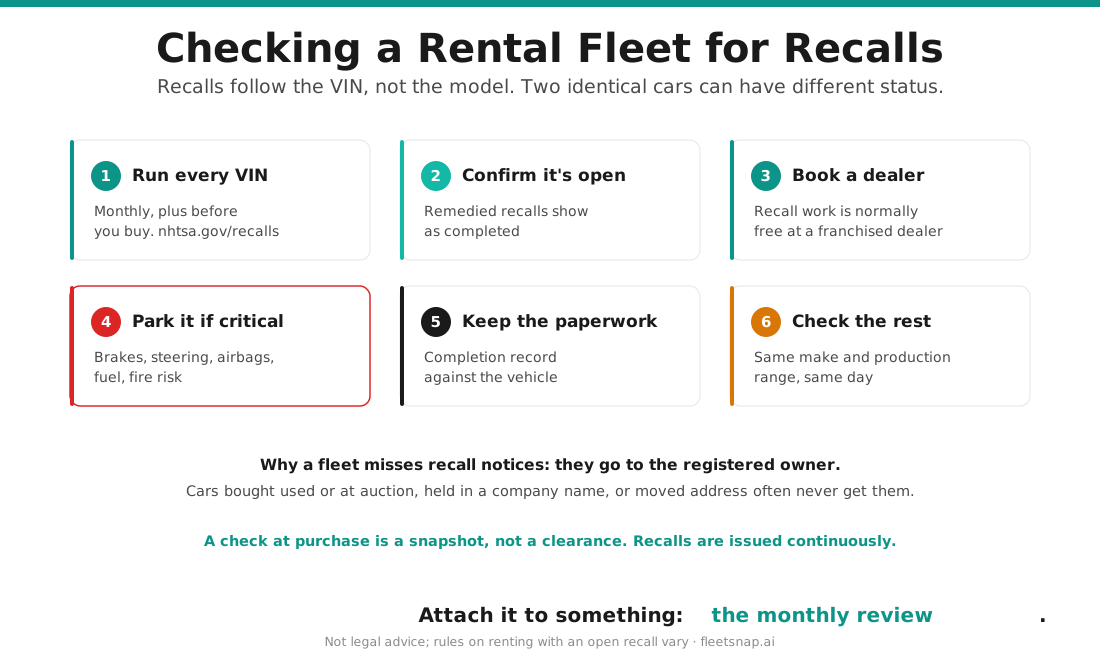
A safety recall on a car you drive yourself is an inconvenience. A safety recall on a car you rent to strangers is a different category of problem, and most independent operators are not checking for them systematically.
The work involved is small. The exposure if you skip it is not.
Why this matters more on a rental fleet
Three reasons it is not the same as owning the car yourself.
Notification does not reach you reliably. Manufacturers notify registered owners, which works reasonably well for a private car bought from a dealer and badly for vehicles bought used, bought at auction, held in a company name, or moved between addresses. A large share of rental fleet vehicles are in at least one of those categories.
The person at risk did not choose the car. Your guest has no way to assess the vehicle and no reason to suspect anything. The entire assessment is yours.
It is a listing and liability question, not only a safety one. An open safety recall is exactly the kind of thing that can take a vehicle off a platform, and a vehicle that is not listed earns nothing while still costing you finance, insurance and depreciation.
Worth stating plainly: the legal position on renting a vehicle with an open recall varies by jurisdiction and circumstance, and it is not something to take from an article. If you have a vehicle with an open safety recall, the sensible default is to get it fixed before it goes out again.
How to check, properly
Recalls are tracked per vehicle by VIN, not by make and model, because recalls apply to production ranges rather than to whole model years. Two cars that look identical on your driveway can have completely different recall status.
By VIN, through the manufacturer or the national safety database. In the US, NHTSA runs a free VIN lookup at nhtsa.gov/recalls, and manufacturers run their own for their vehicles.
At purchase, before anything else. The single best moment to check is before you buy, because an open recall on a vehicle you are considering is useful information about the car and costs you nothing to discover.
On a schedule after that. Recalls are issued continuously, so a check at purchase is a snapshot, not a clearance. Monthly across the fleet is reasonable and takes very little time once it is a routine.
The practical approach for a fleet: keep a list of VINs somewhere you can work through, and run them on a fixed day each month alongside your other recurring checks.
What to do when one comes up
Confirm it is open rather than historical. A lookup shows recalls that remain unremedied. If a previous owner already had the work done, it should show as completed, though records are occasionally imperfect on used vehicles.
Book it with a franchised dealer. Recall work is normally carried out free of charge by the manufacturer's dealer network, regardless of the vehicle's age or how many owners it has had. You are not paying for this.
Take the car off the road until it is done, if the recall is safety-critical. Not all recalls are equal, and the notice will indicate severity. For anything involving braking, steering, airbags, fuel systems or fire risk, the answer is straightforward.
Keep the paperwork. The completion record against that specific vehicle, with the date. This matters for your own records, for resale, and if the vehicle's status is ever questioned.
Check the rest of the fleet at the same time. If one vehicle has a recall, others of the same make and production range may too.
Building it into the routine
The reason this gets skipped is not that operators do not care. It is that it is not attached to anything.
Service intervals are attached to mileage. Inspections are attached to a date. Recall checks are attached to nothing, so they happen when something reminds you, which is usually something going wrong.
Three ways to attach it:
To the monthly vehicle review. Alongside brake condition, battery health and the other monthly items. This is the simplest and it works.
To acquisition. A VIN check as a standard step before purchase, in the same breath as the history check and the service record review.
To any unexplained symptom. If a guest reports something odd that does not match an obvious mechanical cause, a recall lookup is thirty seconds and occasionally explains it immediately.
The connection to guest reports
Worth drawing out, because it is the part that is not obvious.
A recall exists because a fault pattern was identified across many vehicles. Which means the symptoms are, by definition, things drivers noticed and reported.
Your guests are drivers. If several of them mention something similar across your fleet, that is a pattern you are seeing before any database tells you about it. A warning light that comes and goes, an intermittent behavior, something that only happens when the car is cold.
Most operators never see that pattern, because the reports arrive as individual sentences inside messages about parking, weeks apart, read by whoever was on their phone at the time. The pattern exists in the data and nobody is holding enough of it at once to notice.
Where FleetSnap fits
This is a narrow and real fit rather than a stretch.
The AI reads every incoming guest message and ranks it by urgency so the one mentioning a warning light surfaces rather than getting buried. Your team still writes every reply and nothing goes out unattended.
The maintenance agent logs what guests mention against the specific vehicle, which turns scattered sentences into a per-vehicle record. That is what makes a repeating symptom visible as a pattern rather than as three unrelated conversations.
FleetSnap also checks each vehicle's VIN against NHTSA's open recalls and flags any it finds, so a new recall on a car you already own surfaces without anyone remembering to look. Most of our own users do not know it is there, which is partly why this article exists.
What it does not do: it does not book recall work or contact the dealer, and the manufacturer's notice is still the word on severity. Check-in and checkout capture is rolling out to first operators now.
On early FleetSnap fleets, the share of vehicles with an open maintenance issue fell from roughly 15% to under 4%.