
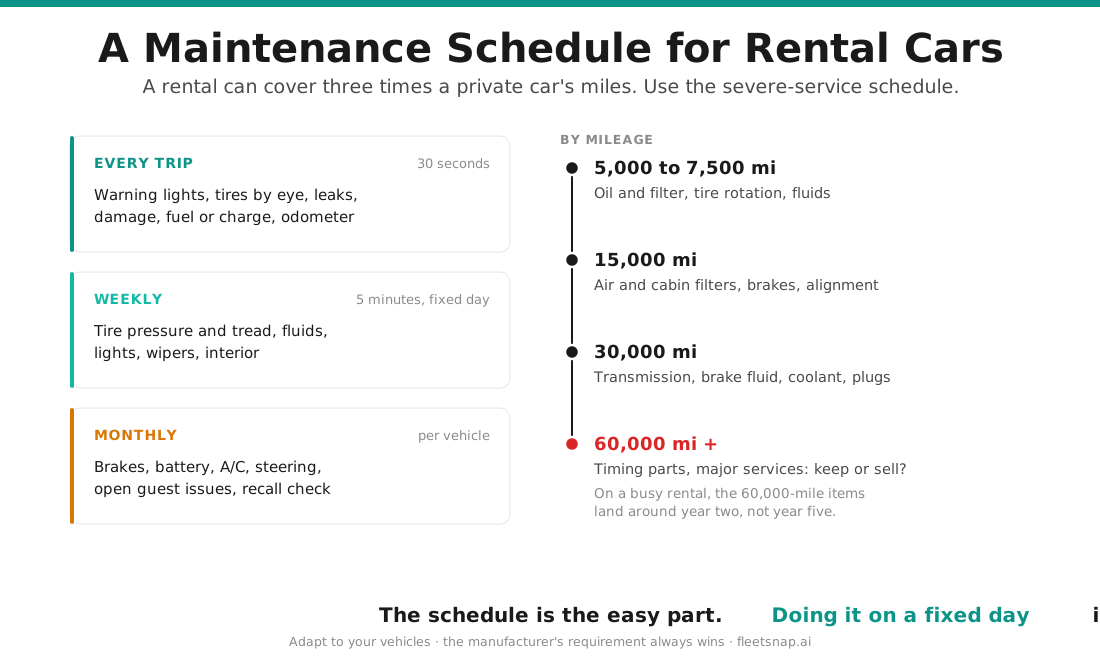
Manufacturer service schedules assume a private owner doing around 12,000 miles a year. A well-utilized rental vehicle can do three times that, which means every interval in the handbook arrives three times faster in calendar terms, and several of them need tightening on top of that because rental use is harder than private use.
This is the version adjusted for that. Adapt it to your vehicles and your market rather than treating it as gospel, and if a manufacturer requirement conflicts with anything here, follow the manufacturer.
Why rental intervals are not manufacturer intervals
Three compounding factors.
Mileage compression. The 30,000 mile service arrives in year one rather than year three. Anything specified in years rather than miles needs translating.
Harder use. A meaningful share of guests drive a car they do not own differently from how they drive their own. Brakes, tires, clutches and suspension take that.
Cold starts and short trips. Rental vehicles accumulate a lot of short journeys and cold starts, which is harder on an engine than the same mileage on a highway.
The practical rule most operators settle on: use the manufacturer's severe-service schedule rather than the normal one, and treat it as a ceiling rather than a target.
Per trip, by whoever handles the car
Thirty seconds. This is not an inspection, it is a glance that catches the obvious.
- Warning lights on the dash at start
- Tire condition by eye, including anything visibly low
- Fluid leaks under where the car was parked
- Damage against the last recorded condition
- Fuel or charge level
- Odometer reading recorded
The odometer matters for two reasons beyond mileage billing. It drives the whole schedule below, and it is the evidence for additional distance charges, which you have 72 hours after the trip ends to submit on Turo.
Weekly, per vehicle
Five minutes, batched across the fleet on a fixed day.
- Tire pressures, properly, with a gauge
- Tread depth checked rather than glanced at
- Fluid levels: oil, coolant, washer fluid
- Lights all round
- Wipers
- Interior condition and anything accumulating
The point of a fixed day is that it happens. A weekly check that occurs when someone remembers is a monthly check with extra steps.
Monthly, per vehicle
- Brake condition inspected, not just listened for
- Battery health, particularly on vehicles doing short trips
- Air conditioning function, because the complaint arrives seasonally and all at once
- Suspension and steering for play or noise
- Any open guest-reported issues reviewed and closed out
- Recall check on the VIN
That last one is worth doing monthly rather than annually, because recalls are issued continuously and a vehicle with an open recall is both a safety matter and a listing risk. We cover it properly in recalls and rental cars.
By mileage, the core schedule
Translate these into your own vehicles' requirements. The point is the frequency relative to use, not the specific numbers.
Every 5,000 to 7,500 miles. Oil and filter, on the severe-service interval rather than the extended one. Tire rotation. Full fluid top-up and inspection.
Every 15,000 miles. Air filter, cabin filter, brake inspection in detail, alignment check. Alignment matters more on rental vehicles than people expect, because curbing happens and nobody reports it.
Every 30,000 miles. Transmission service where applicable, brake fluid, coolant condition, full suspension inspection, spark plugs on many gas vehicles.
Every 60,000 miles and beyond. The expensive ones. Timing components where applicable, major transmission service, suspension components. These are the intervals that decide whether to keep or sell a vehicle, and they arrive in roughly year two of rental life rather than year five.
Annually regardless of mileage. Whatever your market requires. Inspection requirements vary by market and, in the US, by state, so check your host account for what applies to you.
Electric vehicles, which are different rather than simpler
No oil service, which saves real money. Four things that cut the other way.
Tires wear faster. Weight and instant torque. Budget for this properly, it surprises people.
Brake fluid still needs doing even though the pads last much longer under regenerative braking. Pads lasting a long time is also its own problem, because rotors can corrode from underuse.
Battery health is the resale value. Worth tracking and recording from day one, because a documented history is worth money at sale.
Charging behavior by guests affects the battery. Repeated fast charging to 100% is harder on a pack than most guests know or care about.
The seasonal items
Easy to forget because they are not mileage-driven.
Before winter. Battery test, tire tread and type, coolant concentration, heater and defroster function, wiper blades.
Before summer. Air conditioning, cooling system, tire pressures as ambient temperatures change.
Both arrive on the whole fleet at once, which is the actual difficulty. A twenty-car fleet needs this planned across weeks rather than attempted in one.
Making it survive contact with a busy month
The schedule is the easy part. Three things decide whether it actually happens.
Record per vehicle, not per fleet. The question you need answered in a repair shop is what has been done to this car and when. Fleet-level records cannot answer it and quietly stop being updated.
Review open items on a fixed day. Most expensive repairs were known about and then lost in a busy week. A weekly look at what is outstanding catches that.
Capture what guests say. The single highest-value input and the one not on any schedule. A guest mentioning a noise is an earlier warning than any inspection will give you, because they are reporting how the car behaves while being driven and you only ever see it parked.
That third one is where schedules stop being sufficient, and it is why maintenance on a rental fleet is as much an inbox problem as a workshop problem. We go into it in Turo maintenance tracking.
The financial case, briefly
Two reasons this pays beyond avoiding breakdowns.
Downtime is uncompensated. Turo's US earnings plans don't include loss of hosting income or a replacement vehicle while yours is repaired. Every day off the road is finance, insurance and depreciation against zero revenue.
Maintenance is a scored criterion. All-Star Host status requires five-star maintenance ratings on at least 80% of trips as a separate threshold from your overall rating, so vehicle condition has a direct platform consequence.
Where FleetSnap fits
Narrowly, on the part a schedule cannot cover.
The AI reads every incoming guest message and ranks it by urgency so the one mentioning a noise surfaces above the forty about parking. Your team still writes every reply. The maintenance agent takes what guests mention in passing and logs it against the specific vehicle, so it becomes a tracked item rather than a sentence that scrolled past. It flags and logs, it does not book repairs or decide what to do.
On early FleetSnap fleets, the share of vehicles with an open maintenance issue fell from roughly 15% to under 4%.
The earnings tool shows profit per vehicle after maintenance and depreciation, which is how a vehicle with a high maintenance burden finally becomes visible as the problem it is. Free for three reports a month. Check-in and checkout capture is rolling out to first operators now.