
How to Start a Car Rental Business in 2026: The Honest Version
What it actually costs to start a car rental business, how long before it pays, and the decisions that matter most in year one. Real numbers, no fluff.
 By The FleetSnap Team·9 min read
In this guide
- Is a car rental business actually worth starting in 2026
- What it costs to start, broken down
- Choosing your model: Turo, direct rentals, or both
- How many cars you need before it replaces a salary
- Insurance, and why it decides your margins
- Buying the first vehicles without overpaying
- The operations nobody warns you about
- Building the operations layer before you need it
- Your first ninety days, week by week
- Questions hosts ask
Most guides to starting a car rental business are written by people who have never done it. They tell you to write a business plan, register an LLC, and "find your niche." None of that is wrong. None of it is what decides whether you make money.
What decides it is narrower than that, and it is mostly settled in the first three months: what you buy, what you pay for insurance, and whether you have any idea what each car actually nets you.
This is the version written for someone who is about to spend real money.
Is a car rental business actually worth starting in 2026
The honest answer is that it depends almost entirely on your cost of capital and your tolerance for operational work.
The business works like this. You buy an asset that depreciates, rent it out for more than it costs you to hold and maintain, and sell it before the depreciation eats the gains. The marketplaces, Turo chief among them, have made the demand side easy. They have not made the asset side or the operations side easy, and that is where people lose money.
Three things have changed since 2022 and they cut in different directions.
Vehicle prices came down from their peak but financing costs went up, so the monthly carry on a car is roughly where it was. Insurance for commercial and rental use has got harder and more expensive in most states. And the number of hosts has grown substantially, which means more competition on price in saturated metros and much less in secondary markets.
The practical read: it is a worse business than it was in 2021 and a better one than most people doing it realize, because most of them are not measuring properly.
What it costs to start, broken down
Here is a realistic first-vehicle budget. Adjust for your market.
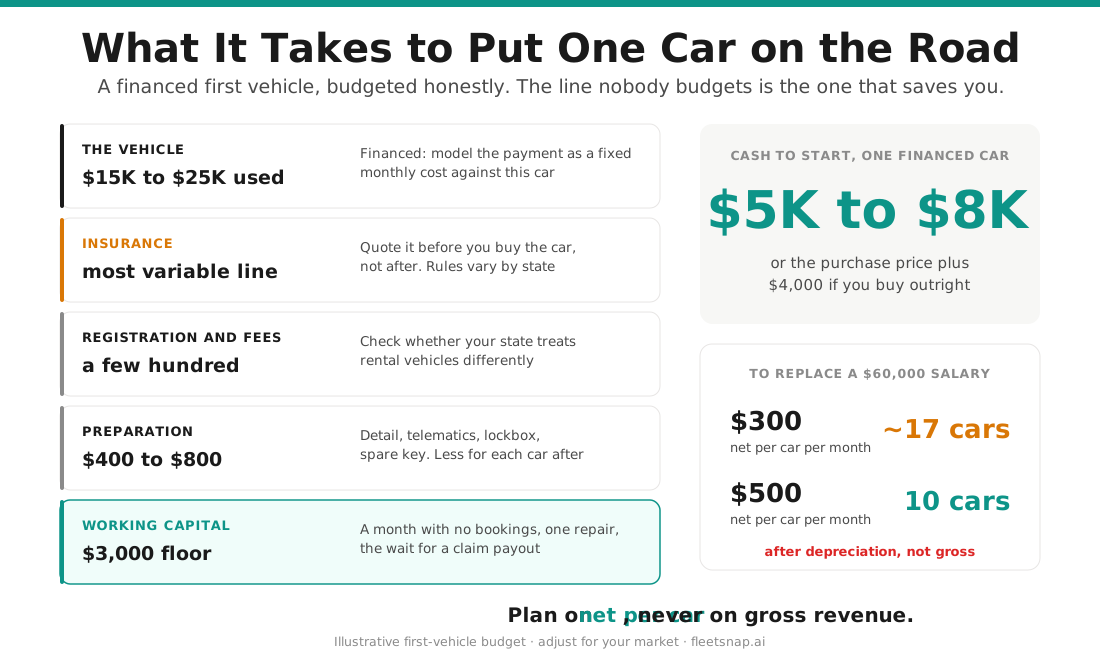
The vehicle. A used vehicle in the $15,000 to $25,000 range is where most operators start. Buying outright kills your cash flow. Financing eats your margin. Most people finance and should model the payment as a fixed monthly cost against the car, not as a general business expense.
Insurance. This is the single most variable line and the one people underestimate most. Platform protection plans cover trips, but what you need outside of trips, and whether you need commercial coverage at all, depends on your state and your volume. Get quotes before you buy the car, not after. Requirements for commercially rented vehicles vary by state, so check your own state's rules rather than a national summary.
Registration, taxes and fees. Varies by state. Budget a few hundred dollars and check whether your state treats rental vehicles differently.
Preparation. Detailing, a dashcam or telematics device, a lockbox or smart lock if you do remote handovers, a spare key. Call it $400 to $800 for the first car and less for each one after.
Working capital. The part nobody budgets. You need enough to cover a month with no bookings, one unexpected repair, and the gap between a damage claim and the payout. $3,000 per vehicle is a reasonable floor.
So realistically: $5,000 to $8,000 of actual cash to put one financed vehicle on the road properly, or the full purchase price plus $4,000 if you buy outright.
Choosing your model: Turo, direct rentals, or both
Platform only. You list on a marketplace, which in the US now effectively means Turo. It brings the demand, takes a cut, and you accept its rules on pricing, protection and claims. Fastest to start, lowest marketing burden, least control. Most people start here and most should. Worth knowing that Getaround, the main alternative until recently, announced the wind-down of its US operations in February 2025, which is a reason to build direct rentals sooner rather than later.
Direct rentals. You find your own customers, set your own terms, keep the full rate, and carry the entire burden of marketing, booking, payment, screening and insurance. Better margins, much harder, and genuinely a different business.
Both. Platform fills the gaps, direct rentals carry the base. This is where most operators end up past about ten vehicles, and it is where the operational complexity jumps sharply, because you are now reconciling two sets of bookings, two sets of payouts and two sets of damage processes.
The decision that matters is not which to start with. It is whether you build the habit of tracking per-vehicle economics early enough that you can tell which one is actually paying you.
How many cars you need before it replaces a salary
This is the question behind the question, so here is the arithmetic rather than a motivational answer.
Net profit per vehicle per month, after platform fees, insurance, maintenance, cleaning, and the finance payment, lands in a wide band depending on your market and vehicle. Operators who measure properly typically report somewhere between $200 and $600 per car per month in net profit, before accounting for depreciation.
Include depreciation, which you should, and that number drops meaningfully. A car losing $3,000 a year in value is costing you $250 a month whether or not you feel it.
So at $300 a month genuinely net per car, replacing a $60,000 salary takes roughly seventeen vehicles. At $500 it takes ten.
The reason most people get this wrong is that they measure gross revenue. Gross revenue per car looks wonderful. It is also almost entirely irrelevant.
Insurance, and why it decides your margins
Insurance is the line item most likely to turn a profitable fleet into an unprofitable one, and it is the one people research last.
The structure you need to understand is that platform protection applies during a trip and typically does not apply the rest of the time. What covers the vehicle between trips, during maintenance runs, or while being moved, is a separate question with a different answer in every state.
To put numbers on it, Turo runs three earnings plans for US hosts. You keep 70% of the trip price with $250 of damage responsibility, 80% with $1,500, or 90% with $2,750. All three include third-party liability up to $750,000 (lower in New York), and none of them include loss of hosting income while a vehicle is off the road. Figures from Turo's help center, checked 13 October 2026. The full structure, including the nine markets where the share moves with booking lead time, is in Turo fees explained, and the gaps are in Turo insurance for hosts.
Get quotes for commercial coverage before committing to the business, because in some markets the premium alone will tell you the answer.
Buying the first vehicles without overpaying
Four rules that hold up across markets.
Buy for depreciation, not for booking rate. The car that books most is rarely the car that earns most, because high-demand vehicles are usually newer and lose value faster. Two cars earning the same gross can differ by thousands a year in what you keep.
Buy common. Parts availability and repair cost matter more than the badge. An unusual vehicle sitting in a shop for three weeks waiting on a part earns nothing and costs you the carry.
Check the maintenance interval schedule before you buy. A vehicle with a 60,000 mile service that costs $1,200 is a different proposition from one that costs $400, and rental vehicles hit those intervals fast.
Model it before you sign. Take the actual purchase price, the actual finance terms, a realistic utilization rate for your market, and work out the monthly net. If it does not clear your threshold on paper it will not clear it in reality.
Best cars for Turo walks through that ranking with current depreciation figures, and you can run the calculation on FleetSnap's free earnings tool before you buy anything.
The operations nobody warns you about
The business is not renting cars. The business is handling what happens around renting cars, and it scales badly if you do not build for it.
Guest messages. At one car this is a minor annoyance. At ten it is a part-time job, and the messages do not respect your schedule. The ones that matter most, a guest mentioning a noise or a warning light, arrive buried in conversations about parking and late pickups.
Turnarounds. Cleaning, fuel or charge, photos, and getting the car ready for the next trip. This is the operational bottleneck for almost every operator between five and twenty vehicles.
Damage. Not the big accidents. The small disputed scuffs, where the entire outcome depends on whether you can prove the condition of the vehicle at handover. Operators who document properly recover most of it. Operators who do not write it off and call it a cost of business. The deadlines are in the Turo damage claim guide.
Maintenance that you did not know about. The expensive repairs are usually the ones that announced themselves weeks earlier, in a message from a guest who mentioned something in passing.
That last one is the specific problem FleetSnap was built for.
Building the operations layer before you need it
Most operators buy software at the point of crisis, usually somewhere around eight to twelve vehicles, after a bad month. It works better the other way round, because the habits you build at two cars are the ones you still have at twenty.
Here is what FleetSnap handles at the start.
Damage. Documented against a specific vehicle and trip, then tracked through to recovery. Most damage goes unrecovered because nobody filed or nobody followed up, not because the claim failed.
Profit per vehicle. True profit after platform fees, running costs and estimated depreciation, which is the number that tells you whether to buy the second car. The earnings tool is free for three reports a month at any fleet size, and it works from day one with a single vehicle.
If you are at one car, start with the free earnings tool and nothing else. It will tell you more about whether this business works for you than any amount of planning.
Your first ninety days, week by week
Weeks 1 to 2. Get insurance quotes. Decide your market and model. Set up the business entity and a separate bank account, because mixing personal and business finances here will cost you at tax time. Turo taxes covers the records to keep from day one.
Weeks 3 to 4. Buy the first vehicle. Model the economics before you commit, not after. Prepare it properly: detail, telematics, spare key, documentation of its exact condition.
Weeks 5 to 8. List it. Price it below market deliberately for the first few trips to build reviews, because early reviews compound and the revenue you give up is the cheapest marketing you will ever buy.
Weeks 9 to 12. This is the part people skip and it is the part that matters. Work out what the car actually netted you across those first trips, after everything, including depreciation. That number, not the gross, is what tells you whether to buy the second car.
Questions hosts ask
Do I need an LLC to start a car rental business?
Not to start, but most operators form one for liability separation once they have a vehicle on the road. Rules and tax treatment vary by state, so this is a question for an accountant rather than a blog post.
How much can I make with one car?
Gross revenue varies enormously by market and vehicle. Net profit after all costs including depreciation is a much narrower band, and it is the only number worth planning on. Run yours through FleetSnap's free earnings tool.
Is Turo or Getaround better for hosts?
Getaround announced the wind-down of its US car-sharing operations, HyreCar included, in February 2025, so in the US the comparison no longer applies. Turo is now effectively the only marketplace of scale, which is the argument for building direct rentals alongside it rather than depending on one channel.
Can I do this as a side business?
At one to three vehicles, yes, with a time cost most people underestimate. Past about five, the operational load requires either software, help, or both.
What is the biggest mistake new operators make?
Measuring gross revenue instead of profit per vehicle, and therefore buying a second car that loses money because the first one appeared to be winning.