Vehicle Damage Inspection App: Documenting Damage So Claims Actually Pay
A damage inspection app is only worth having if the evidence survives a dispute. What to capture, when, and what gets claims denied.
 By The FleetSnap Team·7 min read

In this guide
- What a damage inspection app needs to capture
- Why claims get denied: the four usual reasons
- Timestamps, metadata and chain of evidence
- Before and after: the handover record
- Phone photos vs a structured record
- Recovering damage costs from guests and platforms
- How FleetSnap documents and tracks claims
- Questions hosts ask
Every rental operator has had the same conversation. A car comes back with a scuff on the rear quarter panel. You are certain it was not there at handover. The guest is certain it was. You have forty photos of the car from three weeks ago in a camera roll, none of which show that panel at a useful angle, and no way to prove which trip they came from.
You write it off. It costs a few hundred dollars. It happens again next month.
A vehicle damage inspection app exists to end that conversation before it starts. Most of them do not, because they are built to capture photos rather than to produce evidence. Those are different jobs.
What a damage inspection app needs to capture
The test for any inspection tool is simple. If a guest disputes damage six weeks from now, does what this app produced settle the argument?
That requires four things, and most apps do two or three of them.
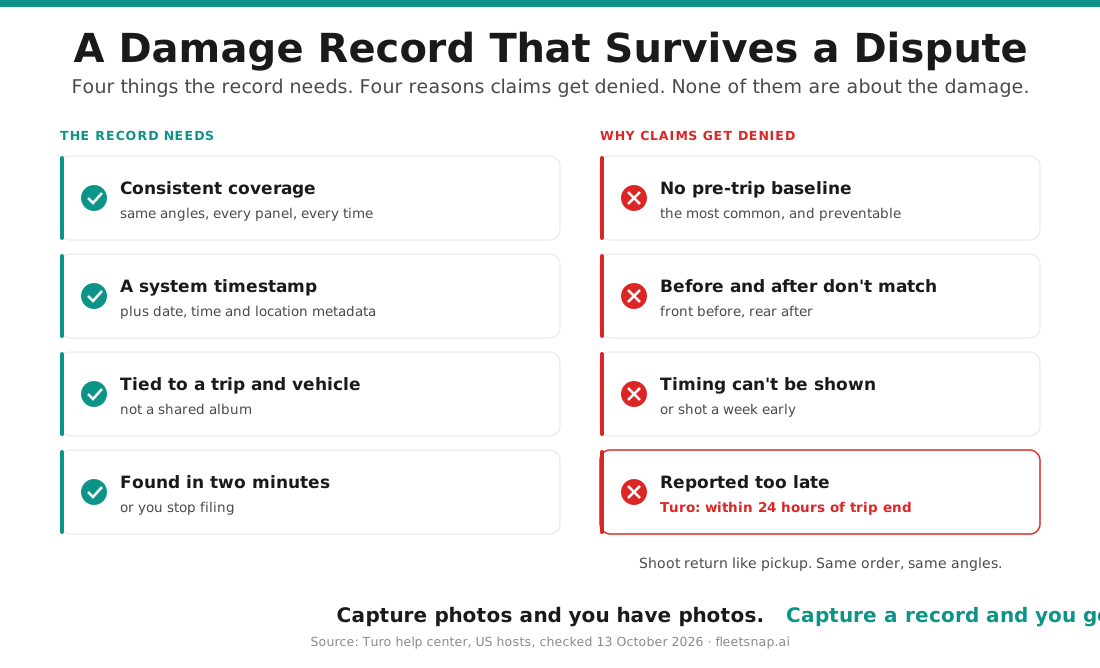
Complete coverage, consistently. Every panel, every wheel, the interior, the odometer, the fuel or charge level. Not "the bits that looked relevant at the time." Consistency matters more than volume, because a dispute turns on whether you can show the same angle before and after.
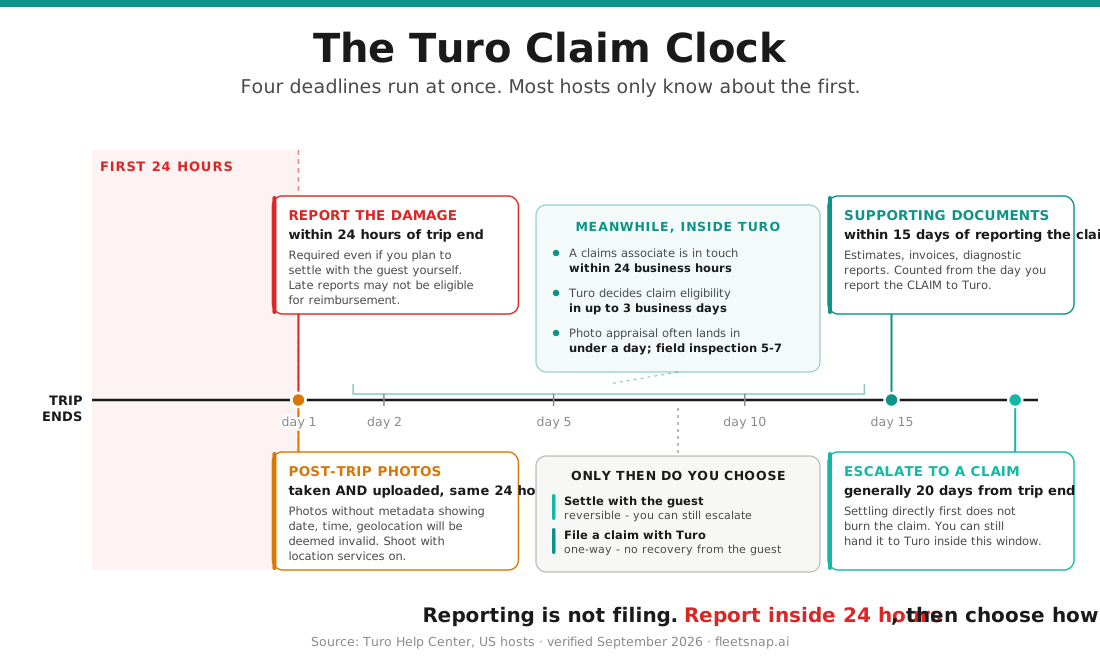
Timestamps that are not editable. A photo with an editable date is not evidence. The capture time needs to come from the system, not from the device's clock or the file's metadata. On Turo specifically, photos without date, time and location metadata are deemed invalid, so shoot with location services on.
Association with a specific trip and vehicle. Photos floating in a shared album prove nothing. The record needs to say: this vehicle, this trip, this guest, this moment.
Retrievability. You need to find it in two minutes when a claim is filed, not spend an evening scrolling a camera roll. If retrieval is hard, the record effectively does not exist.
Why claims get denied: the four usual reasons
Platform damage claims and insurance claims fail for a small number of predictable reasons. All four are documentation problems rather than fairness problems.
No pre-trip baseline. You cannot prove damage happened during a trip if you cannot show the vehicle's condition before it. This is the single most common cause, and it is entirely preventable.
The before and after do not match. You have a photo of the front of the car before and a photo of the rear after. Neither proves anything about the panel in dispute. Standardized angles solve this.
Timing cannot be established. The photos exist but nothing proves when they were taken, or they were taken a week before the trip rather than at handover.
The claim was filed too late. On Turo you must report damage no more than 24 hours after the trip ends to start the resolution process. One day. A perfect record filed outside that window is worth nothing, which is why the capture routine matters less than the habit of actually looking at the car when it comes back. Checked against Turo's help center on 13 October 2026, and laid out with the other claim deadlines in the Turo damage claim guide.
Notice that none of these are about the damage itself. They are about the record.
Timestamps, metadata and chain of evidence
This is the part that separates a photo app from an inspection tool.
A photograph on its own is weak evidence because it is easily edited and carries no inherent proof of when or where it was taken. EXIF metadata helps, but it can be stripped or altered, and it travels badly between devices and messaging apps.
What holds up is a chain: the capture happened inside a system, at a server-recorded time, attached to a known vehicle and a known trip, and it has not been modified since. That chain is what turns a picture into a record.
In practical terms, this is why photographing a car and texting the images to yourself is weaker than it feels. The photos survive. The chain does not.
Before and after: the handover record
The most useful single artifact in damage recovery is a matched pair: the same set of photos at pickup and at return.
The structure that works:
At pickup, capture the standard set. Exterior panels at consistent angles, wheels, interior, odometer, fuel or charge. Note any existing damage explicitly rather than hoping the photos imply it.
At return, capture the identical set, from the same angles. Identical matters. A dispute is resolved by comparing like with like, and a different angle gives the other side room to argue.
Flag differences immediately, while the guest is still present or still reachable. A difference raised at return is a conversation. The same difference raised three days later is an accusation.
Guests often photograph the car at the same handovers. That is not a reason to skip your own set. Your job is to capture a consistent record at the same moments, so you have something to compare theirs against. The full pickup and return sequence, shot by shot, is in Turo check-in and checkout.
Phone photos vs a structured record
To be fair to the camera roll, it is better than nothing, and plenty of operators have recovered damage with nothing more.
Where it breaks is at scale and under pressure.
At one or two vehicles, you remember the trips. You can find the photos. At fifteen vehicles with forty trips a month, you cannot, and the time cost of searching exceeds the value of the claim, so you stop filing claims. That is the real failure mode. Not losing a dispute, but quietly deciding not to have it.
The second break is consistency. Photos taken ad hoc are taken differently each time, usually with more care at the start of a trip than at the end, which is precisely backwards from what a dispute needs.
A structured record fixes both, which is less about technology than about making the right thing the easy thing at six in the evening when a car has just come back and you want to go home.
Recovering damage costs from guests and platforms
Documentation gets you to the claim. Recovery is a separate process with its own failure points.
File immediately. Within the platform's window, which is shorter than you think, and before the vehicle goes out again. A vehicle that has been on another trip since the damage weakens the claim considerably.
Get a real estimate. A repair quote from a shop carries weight. A number you arrived at yourself does not. On Turo, check the shop first: since 18 August 2026, repairs done at facilities on Turo's published ineligible list are not reimbursed.
Check it clears the threshold. Turo does not reimburse exterior wear and tear, defined as dings, dents, cracks or scratches to the exterior body that are 3 inches in diameter or less. What the plans do and do not cover is in Turo insurance for hosts.
Document the loss as well as the damage. Days the vehicle was off the road are a real cost. Turo's US earnings plans don't include loss of hosting income, but you need the number for your own per-vehicle profit picture.
Track the claim to its conclusion. The most common recovery failure after poor documentation is simply losing track. Claims stall, go quiet, and get forgotten in a busy month. Something needs to be carrying the open list.
Keep the record after the claim closes. Patterns across claims are useful. If the same vehicle keeps coming back damaged, that is a pricing or screening signal rather than bad luck.
How FleetSnap documents and tracks claims
FleetSnap handles the documentation and the tracking as one process rather than two tools.
Damage is documented against a specific vehicle and trip, so the record is tied to the booking rather than sitting in a general album. Claims are then tracked through to recovery, with the open ones visible rather than relying on memory, which is where most unrecovered damage actually goes. How to file a damage claim in FleetSnap walks through it end to end.
Check-in and checkout capture is live. Your field team works from the operator portal, where every handover photo is kept with the data showing when and where it was taken.
Questions hosts ask
What should a vehicle damage inspection app capture?
Every exterior panel at consistent angles, all four wheels, the interior, the odometer and the fuel or charge level, with server-recorded timestamps and association to a specific vehicle and trip. On Turo, photos also need date, time and location metadata.
Are phone photos enough to win a damage dispute?
Sometimes, at small scale. They fail when you cannot retrieve them quickly, or when angles are inconsistent between pickup and return.
Why do damage claims get denied?
Most often because there is no pre-trip baseline, because before and after images do not show the same thing, because the timing of the photos cannot be established, or because the claim was filed outside the platform's window.
How soon should I file a damage claim?
On Turo, within 24 hours of the trip ending, which is the window for starting the resolution process. Practically that means inspecting the vehicle on return rather than the next time you happen to be near it, and certainly before it goes out again, since each subsequent trip weakens the claim.
Does documenting damage actually change what I recover?
It changes two things. It improves the outcome of claims you file, and it increases the number you bother to file, which is usually the larger effect.