Should You Decline Same-Day Turo Bookings? We Checked 9,000 Trips.
Plenty of hosts decline same-day bookings to protect their cars. We checked 9,000 real Turo trips to see whether that rule earns its keep — and found the risk works nothing like the way it feels.
 By The FleetSnap Team·6 min readUpdated
In this guide
- Yes, late bookings go wrong more often
- But booking later does not make it worse
- It is not just that late bookings are different trips
- Two things that move risk more than timing does
- One thing that makes no difference at all
- So should you decline same-day bookings?
- Appendix: how we did this, and the exact numbers
- Questions hosts ask
Plenty of experienced hosts decline same-day bookings. The logic is hard to argue with: somebody booking two hours before pickup has not planned anything, and an unplanned trip feels like a trip where something goes wrong.
We checked it against 8,955 real Turo reservations — every trip our concierge inbox handled over six months, matched to what actually happened on it.
The instinct is right. The rule built on it is not.
- 8,955
- reservations, matched to what happened on the trip
- 1 in 11
- bookings made within 24 hours had a real problem, against 1 in 14 booked earlier
- 8.55–9.61%
- problem rate by hour the booking arrived: no real difference
Source: FleetSnap concierge inbox, 1 March to 8 September 2026. Full method in the appendix below.
Yes, late bookings go wrong more often
Split every trip on whether the booking came in within 24 hours of pickup:
- Booked within 24 hours — a real problem about 1 in 11 times
- Booked earlier than that — about 1 in 14
So the instinct holds up. Same-day bookings do go wrong more often, and the gap is big enough that it is not a quirk of which six months we happened to look at.
The interesting part is what happens when you stop treating "last-minute" as one thing.
But booking later does not make it worse
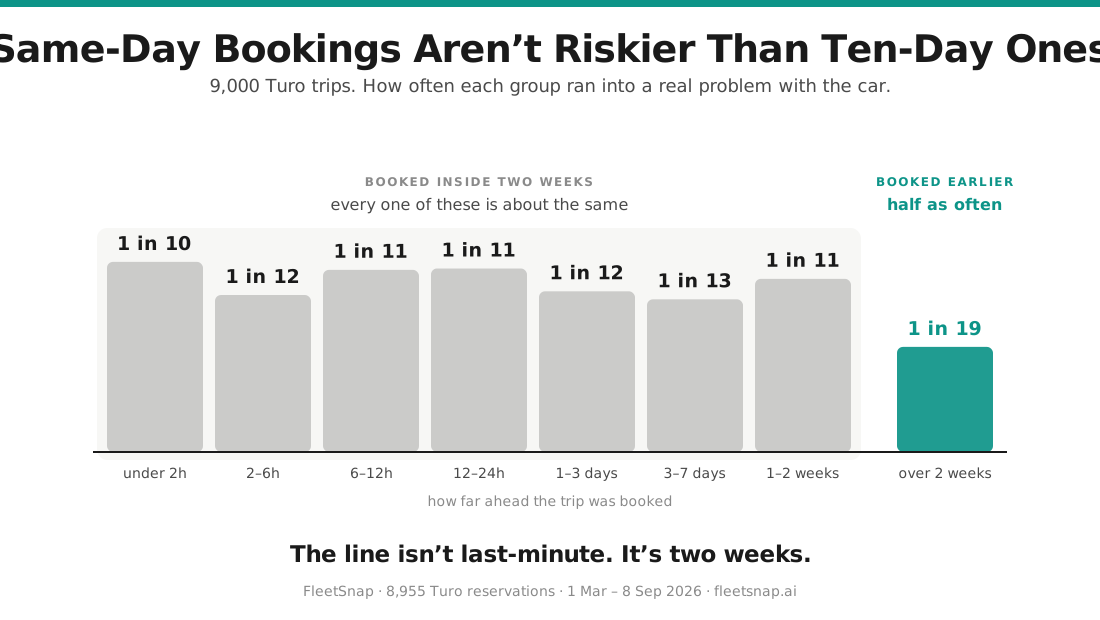
| Booked | Trips | Ran into a problem |
|---|---|---|
| Less than 2 hours ahead | 482 | 1 in 10 |
| 2 to 6 hours | 472 | 1 in 12 |
| 6 to 12 hours | 364 | 1 in 11 |
| 12 to 24 hours | 1,073 | 1 in 11 |
| 1 to 3 days | 1,190 | 1 in 12 |
| 3 to 7 days | 1,265 | 1 in 13 |
| 1 to 2 weeks | 1,160 | 1 in 11 |
| More than 2 weeks | 2,949 | 1 in 19 |
Read down that last column. A trip booked two hours ahead is no riskier than one booked ten days ahead. Everything from "two hours" to "two weeks" lands in the same place — roughly one trip in eleven or twelve.
Then, past two weeks, it drops off a cliff. Those trips run into a problem about half as often.
So there is no last-minute band to decline, because there is no steady climb to cut. There are two kinds of booking: normal ones, which is nearly everything, and genuine advance planning, which is unusually safe.
That matters for what the rule costs you. Declining same-day bookings means turning away revenue to avoid a risk that is spread evenly across almost every booking you take — including the ones you are happily accepting.
It is not just that late bookings are different trips
The obvious objection is that last-minute bookings might simply be different — shorter, cheaper, a different kind of guest — and lead time is along for the ride.
We checked the biggest candidate. Group trips by how long they run, and inside every group, the late bookings still ran into more problems. Short trips, medium trips, long trips: same pattern each time. Lead time is doing its own work, not standing in for trip length.
Two things that move risk more than timing does
While we were in there, two other patterns turned out to be larger than the whole last-minute effect.
Longer trips run into more problems. Trips of two days or less had a problem about 1 in 21 times; six days or more, about 1 in 11.
So do pricier trips. Under $150, about 1 in 24. Over $400, about 1 in 9.
Neither of those is a reason to change what you accept, and we want to be clear about that. A six-day booking is six days of exposure and roughly three times the revenue of a two-day one — more days simply means more chances for something to come up. A $400 trip is usually a nicer car with bigger repair bills attached. Both of those are ordinary, and both are the business working as intended.
They are worth knowing for a different reason: if you are screening bookings for risk and only looking at how far ahead they were made, you are watching the smallest of the three signals.
One thing that makes no difference at all
We also checked whether the time of day a last-minute booking arrives tells you anything — whether a 2am booking is a worse sign than a 2pm one.
It does not. Morning, afternoon, evening, overnight: the rate barely moves. A booking that lands at 3am is no more likely to end badly than one that lands over lunch.
So should you decline same-day bookings?
On this evidence, no — not as a blanket rule.
The penalty is real, but it is not concentrated where the rule points. You would be refusing bookings from the same broad pool of trips you already accept without a second thought, and giving up the revenue to do it.
What the numbers actually support:
- Do not read the clock. The hour a booking arrives tells you nothing.
- Know that long and expensive trips carry more. Not as a reason to avoid them — they earn more too — but so the arithmetic is honest when you price them.
- Expect it anywhere. Even among the safest trips we looked at, roughly one in twenty-five still ran into something.
That last one is the part no booking rule fixes. Problems do not announce themselves at the point of booking; they arrive later, in the inbox, looking exactly like a question about the wifi until somebody opens them.
Appendix: how we did this, and the exact numbers
The data. 8,955 reservations handled through FleetSnap's concierge inbox between 1 March and 8 September 2026, matched to their trip records. A further 743 were excluded because the first message arrived after the trip had started, which makes any "how far ahead" measure meaningless.
"Real problem" means a message our AI classified as damage, a vehicle issue, a breakdown, a mechanical failure, a safety incident, or an emergency. We deliberately did not build this on the "urgent" flag: a same-day booking gets flagged urgent almost automatically, because the booking message itself is the urgent thing. Counting urgent flags instead of real problems would roughly double the apparent last-minute effect.
Lead time is a stand-in. Turo does not give us the moment a booking was made, so we use the first message on the reservation. For same-day trips those are nearly identical; for a trip booked a month out the first message may arrive days later, which blurs the long-lead figures toward the middle and works against the two-week gap we found.
| Comparison | Rates | Significance |
|---|---|---|
| Booked within 24h vs. earlier | 9.20% vs 6.99% | z = 3.49, p = 0.0005 |
| Booked inside 2 weeks vs. beyond | 8.66% vs 5.39% | z = 5.49, p < 0.0000001 |
| Late vs. early, trips of 3–5 days | 9.51% vs 6.60% | z = 3.60, p = 0.0003 |
| Late vs. early, trips of 6+ days | 12.14% vs 8.93% | z = 2.00, p = 0.045 |
| Trip length, 2 days vs 6+ days (booked early) | 4.71% vs 8.93% | independent of lead time |
| Trip price, under $150 vs over $400 (booked early) | 4.15% vs 11.48% | independent of lead time |
| Hour of day the booking arrived | 8.55% – 9.61% | every comparison p > 0.45 |
What we could not settle. We expected how the guest collects the car to matter and could not get a stable answer. Splitting on whether a delivery fee was charged shows the late-booking penalty on no-fee trips and not on delivered ones — but only 610 delivered reservations were booked late, and the fee amounts do not line up with risk in any consistent order: no fee 7.35%, under $20 10.01%, $20–50 4.71%, over $50 7.61%. The safest of those rests on 30 problems, and the riskiest also has the longest trips. A host who delivers for free is recorded as charging nothing, so even the "no fee" group is not a clean comparison. Handover deserves its own study.
Two results we are not claiming. Trips over 300 miles and trips over $400 both showed the late-booking effect running backwards, but each rests on a few hundred trips and neither is large enough to separate from chance.
Questions hosts ask
Should I decline same-day Turo bookings?
On this evidence, not as a blanket rule. Trips booked within 24 hours did run into a real problem more often — about 1 in 11 against 1 in 14 — but the risk does not climb as bookings get later. A trip booked two hours ahead is no riskier than one booked ten days ahead, so declining same-day bookings turns away revenue to avoid a risk shared by almost every booking you already accept.
When do Turo bookings actually get risky?
The dividing line is about two weeks, not the last minute. Trips booked more than two weeks ahead ran into a problem roughly 1 in 19 times. Everything booked inside two weeks — from two hours to thirteen days — sat at about 1 in 12, with no meaningful difference between those bands.
Are longer Turo trips riskier?
They run into more problems, but that is largely what you would expect: a six-day rental is six days of exposure, and it earns roughly three times what a two-day one does. Trips of two days or less had a problem about 1 in 21 times; six days or more, about 1 in 11. It is worth knowing when you price a long booking, not a reason to avoid one.
Do Turo bookings made late at night go wrong more often?
No. Among bookings made within 24 hours of the trip, the rate barely moved between morning, afternoon, evening and overnight — every comparison was well within the range you would expect from chance. The hour a booking arrives carries no signal.
Does delivering a Turo car reduce risk?
We could not get a clear answer. Trips where no delivery fee was charged showed the late-booking penalty and delivered trips did not, but only 610 delivered reservations were booked late, and the fee amounts do not line up with risk in any consistent order. A host who delivers for free is also recorded as charging nothing, so the groups are not clean. We are not reporting a delivery effect in either direction.