
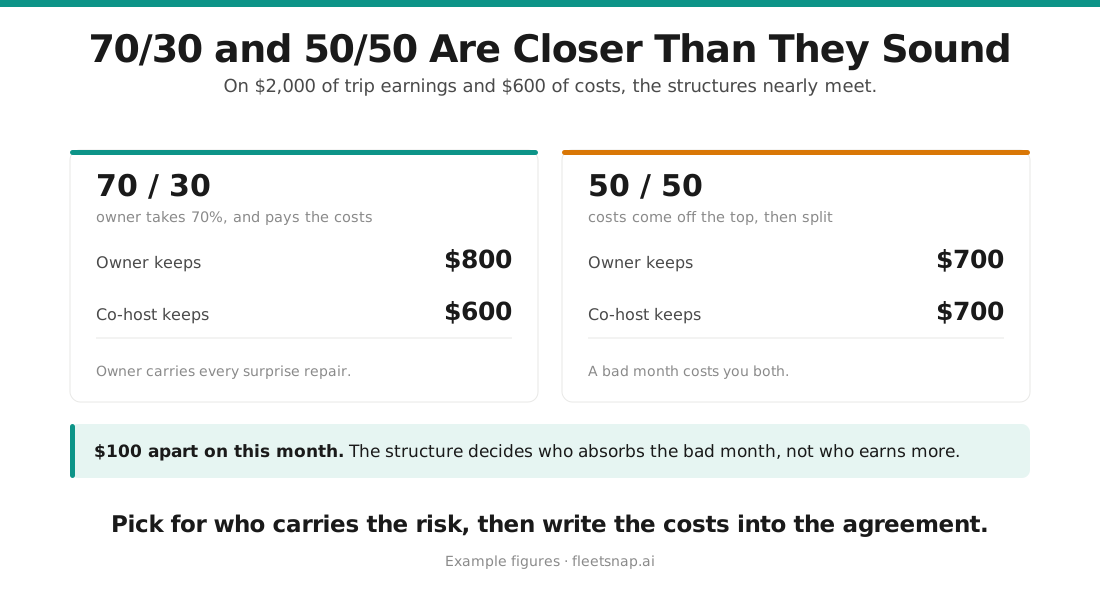
A Turo co-host split is how you and a vehicle owner divide the money a car makes. You'll see splits quoted as 65/35 or 75/25, but in practice the two structures that actually hold up are:
- 70/30 -- owner keeps 70%, co-host keeps 30%, and the owner covers all the costs. The most common setup.
- 50/50 -- split evenly, with costs shared 50/50 between both parties. A true partnership.
Short answer: 70/30 is the clean, predictable choice when the owner wants hands-off income and covers the costs; 50/50 makes sense when you're a true partner sharing both the costs and the upside. The percentage alone tells you almost nothing -- what matters is who covers costs and what you net after them. This guide shows the math, when each makes sense, and the red flags that turn a "good" split into a money loser.
How Turo co-host splits work
The split is applied to net revenue -- what the car earns after Turo's host fee -- not the headline price guests paid. Then, separately, someone has to cover operating costs:
- Cleaning and turnover
- Maintenance (oil, tires, brakes)
- Repairs and damage handling
- Gas / charging between trips
- Tolls, parking, delivery
Who covers those costs changes your real take-home far more than the headline percentage does -- which is exactly why the two structures that work each pair the split with a clear cost rule: 70/30 (owner covers costs) or 50/50 (costs shared).
Worked example
Illustrative only -- model your own vehicle's real numbers below. Assume a car nets $2,000/month after Turo's fee:
70/30 vs 50/50 on $2,000/month net (illustrative, ~$200/mo costs)
| Structure | Owner share | Co-host share | Who covers costs | Co-host net | Owner net |
|---|---|---|---|---|---|
| 70/30 (owner covers costs) | $1,400 | $600 | Owner | $600 | $1,200 |
| 50/50 (costs shared) | $1,000 | $1,000 | Split 50/50 | $900 | $900 |
When each structure makes sense
70/30 (owner covers all costs) makes sense when:
- The owner wants hands-off, passive income and is happy to cover costs
- The car is easy: reliable, in-demand, low-maintenance
- You want clean, predictable income with zero cost exposure
- You're managing many owners and want one simple structure to administer
50/50 (costs shared) makes sense when:
- It's a true partnership and both sides are actively involved
- You want a bigger share of the upside and will share the costs and risk
- The car is higher-touch or higher-cost, so splitting costs is fairer
- You're confident in the car's economics
If you're doing all the work AND covering all the costs, neither structure is fair to you -- that's a sign to renegotiate who pays for what before you sign.
The right answer is per vehicle, not a blanket policy. Run each car's real net against your real costs before you agree to anything.
Red flags to avoid
- A split that doesn't cover your costs. If your share minus cleaning, gas, and management time is near zero, the deal isn't worth your calendar.
- Vague cost responsibility. "We'll figure out maintenance later" always ends with you paying. Define it up front.
- Splitting on gross, not net. Splitting the headline trip price overpays the owner relative to your actual payout.
- No minimum or floor. A slow month can leave you doing full management for almost nothing. Consider a management minimum per vehicle.
- Stacking low-margin cars. Ten cars at a bad split is just ten times the work for the same thin margin. Quality of deal beats quantity.
- No written agreement. Split, costs, minimums, damage liability, and termination terms all belong in writing before trip one.
Bottom line
The headline percentage is the wrong first question. The two structures that actually work each pair the split with a cost rule: 70/30 with the owner covering costs, or 50/50 with costs shared. Pick based on who covers costs and how involved each side is, model it on the car's real numbers, and put it in writing. A clean structure on a good car beats a generous-looking split that quietly costs you money.

FleetSnap transformed how we run Dream Go Rentals -- vehicles, maintenance, inspections, and performance all in one place. Whether you run 10 cars or hundreds, it's the visibility and control you need to scale.
-- Ariel Gomez, Founder & CEO, Dream Go Rentals